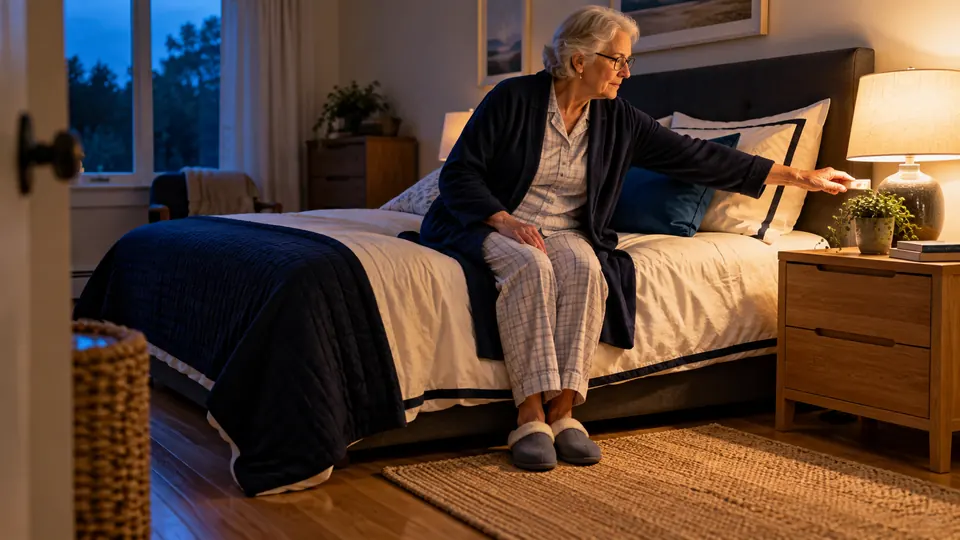

Poor vision can contribute to falls around the bed and during nighttime transfers. If someone cannot clearly see the edge of the mattress, the floor surface, nearby furniture, or obstacles along the route to the bathroom, it may be harder to move safely. Reduced depth perception, contrast sensitivity, peripheral vision, and low-light vision can all make nighttime navigation more challenging.
Vision is usually only one part of fall risk. Mobility limitations, medications, balance problems, bed height, lighting, and the bedroom environment can interact with visual impairment. Addressing both vision and the surrounding environment can therefore be an important part of preventing bed-related falls.
Quick answer
Yes. Poor vision can increase the risk of bed-related falls by making it harder to judge distances, identify obstacles, see the edge of the bed, and navigate safely in low light. The risk may be greater when vision problems occur alongside balance difficulties, muscle weakness, medication effects, or an unsafe bedroom environment. Improving lighting, addressing treatable vision problems, removing hazards, and making transfers easier can help reduce risk.
Why this matters
A fall beside or from a bed can cause bruises, fractures, head injuries, and loss of confidence. For older adults and people with mobility limitations, a fall may also lead to fear of getting out of bed or moving independently at night.
Vision problems are particularly relevant because many nighttime activities depend on being able to identify the bed edge, judge the distance to the floor, locate a mobility aid, and navigate a dark or unfamiliar route. Understanding why seniors fall out of bed can help caregivers recognize how vision problems may interact with mobility, medications, nighttime movement, and the bedroom environment.
How poor vision can contribute to bed falls
Vision is an important part of spatial orientation and safe movement. The eyes provide information about where the edge of the bed is, how far away the floor appears, where nearby furniture is located, and whether obstacles are present along a walking route.
Several aspects of vision can affect these tasks:
- Depth perception. Difficulty judging distances can make accurate foot placement more challenging when getting into or out of bed.
- Contrast sensitivity. When similar colors and shades are difficult to distinguish, the edge of a mattress, a rug, a step, or another object may be harder to see.
- Peripheral vision. Reduced visual fields can make obstacles beside the bed or along walking routes less noticeable.
- Low-light vision. Some eye conditions and age-related changes make navigation more difficult when lighting is limited.
- Blind spots or areas of reduced vision. Depending on their location, these can make particular objects or hazards harder to detect.
People with impaired vision may compensate by relying more heavily on memory, touch, and familiarity with the room. These strategies can be useful, but unexpected changes such as moved furniture, an object left on the floor, or unfamiliar surroundings can create additional difficulty.
How bed-related falls can happen
Many incidents occur during ordinary movements that require a combination of vision, balance, strength, and coordination.
- Getting out of bed at night. Limited lighting can make the mattress edge, floor, rugs, footwear, and other objects difficult to see.
- Sitting near the edge of the bed. Reduced depth perception or contrast may make it harder to judge position relative to the mattress edge.
- Standing after waking. Someone who is sleepy, visually disoriented, weak, or dizzy may have difficulty stabilizing after standing.
- Reaching for objects. Reaching too far for glasses, a phone, a lamp, or another item can shift the body’s center of gravity and reduce stability.
- Transferring between the bed and a mobility device. Moving to a walker, wheelchair, or other support requires accurate positioning and safe foot placement.
- Walking to the bathroom. Poor vision can make clutter, rugs, thresholds, cords, and other hazards more difficult to identify at night.
Vision problems that may affect nighttime safety
Different eye conditions affect vision in different ways. The practical impact on fall risk depends on the severity of the condition, the person’s mobility and balance, and the surrounding environment.
Cataracts
Cataracts can reduce visual clarity and contrast and increase sensitivity to glare. These changes may make nighttime navigation and identifying low-contrast objects more difficult.
Age-related macular degeneration
Age-related macular degeneration primarily affects central vision. Depending on its severity, this can make detailed visual tasks and identifying particular objects more challenging.
Glaucoma
Glaucoma can lead to loss of visual field. Reduced peripheral awareness may make objects, furniture, steps, or other hazards outside the central field of view more difficult to detect.
Diabetic eye disease
Diabetic retinopathy and other diabetes-related eye problems can affect visual clarity or produce areas of impaired vision. Anyone experiencing new or sudden visual changes should seek appropriate professional assessment.
Low vision from other causes
Many other eye conditions can reduce visual acuity, contrast sensitivity, visual field, or other aspects of vision. What matters for fall prevention is understanding how the person’s particular visual limitation affects everyday movement.
Corrective lenses and nighttime movement
Corrective lenses can substantially improve vision, but the type of lens and the activity being performed can matter. Multifocal lenses such as bifocals and progressive lenses contain different viewing zones, which can affect how the ground or nearby objects appear to some users during walking.
This does not mean that everyone using multifocal lenses should stop wearing them. People who notice difficulty judging steps, floor level, or obstacles while wearing their current lenses should discuss the problem with an optometrist or ophthalmologist.
Another simple concern is access to glasses. Someone who normally depends on corrective lenses may have difficulty navigating safely if their glasses are left across the room rather than beside the bed.
Medication and other factors affecting vision
Some medications can contribute to blurred vision, dizziness, drowsiness, or other symptoms that may affect safe mobility. These effects become particularly relevant when they occur alongside existing visual impairment.
New visual symptoms, dizziness, or balance problems that appear after starting or changing medication should be discussed with the prescribing healthcare professional. Medication should not be stopped or changed independently because of fall concerns.
Lighting, glare, and contrast
The bedroom environment can either compensate for poor vision or make it more difficult to navigate. Insufficient lighting can hide hazards, while poorly positioned bright lights may create uncomfortable glare or strong shadows.
Low contrast can also make important boundaries harder to distinguish. For example, a bed, floor, rug, and nearby furniture with very similar colors may provide fewer visual cues for someone with reduced contrast sensitivity.
Risk factors that can compound vision-related fall risk
Visual impairment often interacts with other factors rather than acting alone.
- Older age. Vision changes may occur alongside changes in strength, balance, and reaction time.
- Multiple medications. Some medications can contribute to dizziness, drowsiness, or visual symptoms.
- Previous falls. A history of falls or near-falls is important information when evaluating future risk.
- Mobility limitations or weakness. Reduced strength or impaired gait can make visual errors more difficult to correct.
- Cognitive impairment. Cognitive changes can affect orientation, judgment, and the ability to respond to visual information.
- Frequent nighttime bathroom trips. Repeated nighttime movement increases exposure to low-light conditions and bedroom hazards.
- Unsafe bedroom layout. Clutter, loose rugs, unstable furniture, cords, and unsuitable bed height can compound visual limitations.
Who is most at risk?
People with both visual impairment and other mobility or health limitations may face greater risk than people with poor vision alone.
- An older adult with cataracts, reduced leg strength, and inadequate nighttime lighting.
- A person with reduced peripheral vision who has clutter or poorly contrasted objects near the bed.
- Someone with diabetic eye disease who also experiences medication-related dizziness.
- A person with significant visual impairment who frequently needs to get out of bed during the night.
- Someone with both poor vision and balance problems who has already experienced falls or near-falls.
Temporary or sudden changes in vision can also affect safety and may require prompt medical attention depending on the symptoms involved.
Practical prevention strategies
Reducing vision-related bed fall risk usually involves two approaches: addressing vision problems when possible and adapting the environment so that safe movement depends less on perfect vision.
Maintain appropriate eye care
- Arrange appropriate eye examinations. An optometrist or ophthalmologist can identify vision problems, update prescriptions, and evaluate eye conditions.
- Report significant changes. New or sudden changes in vision should not simply be attributed to aging.
- Discuss nighttime difficulties. Tell the eye care professional if glare, low-light vision, stairs, or nighttime walking have become difficult.
- Discuss treatment options for diagnosed eye conditions. When a treatable condition such as cataracts substantially affects vision, an eye specialist can explain the available options, expected benefits, and risks.
- Consider low-vision services when appropriate. People with persistent visual impairment may benefit from specialized strategies and assistive technology.
Keep corrective lenses accessible
- Keep glasses within easy reach. Someone who depends on glasses should not have to cross the room without them after waking.
- Keep lenses clean and in good condition. Scratched or dirty lenses can further reduce useful vision.
- Discuss problems with multifocal lenses. If bifocals or progressive lenses make it difficult to judge the floor, stairs, or nearby objects, ask an eye care professional whether another approach would be useful for particular activities.
Improve bedroom lighting
Appropriate lighting can compensate for some visual limitations and make environmental hazards easier to identify.
- Keep a bedside light within easy reach. The person should be able to illuminate the area before attempting to stand.
- Use lighting along the route to the bathroom. Motion-activated or appropriately positioned night lighting can reduce the need to navigate in darkness.
- Reduce unnecessary glare. Position lights so that they illuminate walking surfaces without shining directly into the person’s eyes.
- Avoid abrupt dark areas. Hallways, bathroom entrances, and other nighttime routes should provide enough illumination to identify obstacles.
- Test the setup from the person’s perspective. Lighting that appears adequate to a caregiver may still be insufficient for someone with impaired vision.
Increase useful contrast
Contrast can make important objects and boundaries easier to identify for some people with visual impairment.
- Choose bedding that is visually distinguishable from the surrounding floor and furniture when possible.
- Use contrasting colors for important grab bars or other supports when this helps the person locate them.
- Make steps, thresholds, and changes in floor level easier to identify when appropriate.
- Avoid excessive visual clutter that makes important objects harder to distinguish.
Remove trip hazards and keep routes predictable
- Keep a clear path between the bed, bathroom, and doorway.
- Remove or securely manage loose rugs.
- Keep electrical cords and charging cables away from walking routes.
- Address loose flooring and problematic thresholds.
- Keep frequently used objects in consistent, easy-to-reach locations.
- Avoid unnecessary furniture rearrangement when someone relies heavily on familiarity with the room.
Adjust the bed and surrounding furniture
- Review bed height. A bed that is substantially too high or too low for the individual can make transfers more difficult.
- Keep stable supports available when appropriate. Do not rely on lightweight furniture that can move or tip when someone uses it for balance.
- Keep mobility aids accessible. A walker or cane should be positioned where it can be reached safely if the person uses one.
- Consider bed rails carefully. A bed rail may provide support or help reduce rolling from bed for some people, but it can also introduce entrapment, climbing, or transfer hazards and is not appropriate for everyone.
If a bed rail has been determined to be appropriate for an older adult, our guide to safety bed rails for seniors explains the main designs and features to consider. Product choice should take the person’s mobility, cognition, mattress and bed configuration, and reason for using the rail into account.
Use mobility aids appropriately
- Use properly fitted mobility aids when needed. Canes and walkers should be suitable for the person and used correctly.
- Consider gait and balance assessment. A physical therapist can assess strength, walking, balance, and transfers when mobility is a concern.
- Consider occupational therapy. An occupational therapist can evaluate bedroom routines and recommend practical environmental adaptations.
Review medications when symptoms occur
If blurred vision, dizziness, drowsiness, or balance problems appear after a medication change, discuss them with a healthcare professional or pharmacist. Do not independently stop a prescribed medication or change its dose or timing.
Make nighttime routines more predictable
Reducing unnecessary rushing can improve safety. Frequently used items such as glasses, a phone, an appropriate alert device, and a bedside light can be kept within easy reach.
People who frequently need to use the bathroom at night may benefit from reviewing the route, lighting, footwear, mobility aids, and other hazards. Medical concerns such as frequent nighttime urination should be discussed with an appropriate healthcare professional rather than managed solely by restricting fluids.
Support safe orientation after waking
Some people need a moment to become fully alert and oriented after waking. Avoid rushing immediately from lying down to walking, particularly when the person also experiences dizziness, weakness, or difficulty seeing in low light.
Recurring dizziness after standing should be discussed with a healthcare professional rather than assumed to be caused by poor vision.
Common mistakes to avoid
Well-intentioned changes can sometimes provide too little protection or introduce new hazards.
- Relying on inadequate lighting. A very dim nightlight may not provide enough illumination for someone with significant visual impairment.
- Creating excessive glare. Very bright or poorly positioned lights can make navigation uncomfortable or more difficult for some eye conditions.
- Assuming one type of corrective lens is right for every activity. People who experience difficulty judging the floor or steps through multifocal lenses should discuss the issue with an eye care professional.
- Keeping glasses out of reach. Someone who depends on corrective lenses should not need to navigate the room without them simply to retrieve them.
- Installing bed rails without assessing suitability. Bed rails can create hazards for some users and should not be treated as a universal fall-prevention solution.
- Changing the bedroom layout frequently. People with substantial vision loss may rely on familiarity with furniture placement.
- Ignoring changes in vision. New or worsening visual problems deserve appropriate evaluation.
When professional help may be needed
Professional assessment is particularly important when vision changes are substantial, falls have already occurred, or visual impairment is accompanied by other mobility or health concerns.
Seek eye care when
- Vision has noticeably worsened.
- Nighttime or low-light vision has become significantly more difficult.
- Existing corrective lenses no longer provide adequate vision.
- New visual symptoms or blind areas appear.
- Visual problems are interfering with safe walking or transfers.
Sudden vision loss, new severe visual disturbances, or other acute eye symptoms can require urgent medical assessment. The appropriate response depends on the symptoms and circumstances.
Other professionals who may help
- Primary care clinician. Can evaluate overall health and other possible contributors to falls, such as dizziness, blood pressure changes, or medication effects.
- Pharmacist. Can review medications for possible interactions or side effects affecting vision, alertness, or balance.
- Physical therapist. Can assess gait, strength, balance, and transfer ability.
- Occupational therapist. Can evaluate bedroom routines and recommend environmental and functional modifications.
- Low-vision rehabilitation professional. Can provide strategies and assistive tools for making better use of remaining vision.
Frequently asked questions
How often should someone at risk of falls have an eye exam?
The appropriate schedule depends on age, eye health, medical history, and existing eye conditions. People with diagnosed eye disease should follow the examination schedule recommended by their optometrist or ophthalmologist. New or significant changes in vision should be assessed rather than waiting for the next routine appointment.
Can cataract treatment help reduce fall risk?
Cataract treatment can improve visual clarity and other aspects of vision for appropriate patients. Better vision may make navigation easier, but the effect on fall risk varies because falls usually have multiple causes. Decisions about cataract surgery should be made with an ophthalmologist based on the individual’s vision, health, needs, and expected benefits and risks.
Are bed rails a good solution for people with poor vision?
Not automatically. Bed rails may provide support or help reduce rolling from bed for some individuals, but they can also create entrapment, climbing, or transfer hazards. Poor vision alone is not a reason to install a bed rail. The person’s mobility, cognition, bed configuration, and specific reason for needing support should all be considered.
Can nighttime lighting make bed transfers safer?
Appropriate lighting can make the bed edge, floor, mobility aids, and nearby obstacles easier to see. The best setup depends on the person’s visual needs. Lighting should provide useful visibility without excessive glare and should be accessible before the person begins moving.
Are bifocals or progressive lenses unsafe for nighttime walking?
They are not automatically unsafe. However, the different viewing zones in multifocal lenses can affect how the ground, steps, or nearby objects appear to some people. Anyone who notices difficulty navigating while wearing multifocal lenses should discuss the problem with an eye care professional rather than changing lenses independently.
What bedroom changes are most useful for someone with poor vision?
Useful changes often include improving lighting, maintaining clear and predictable walking routes, keeping glasses and mobility aids within reach, removing trip hazards, improving useful contrast, and making sure the bed is suitable for safe transfers. The most important modifications depend on the person’s specific visual and mobility limitations.
When should I involve an occupational therapist or low-vision specialist?
Professional assistance may be useful when visual impairment continues to interfere with safe movement despite basic environmental changes, after repeated falls or near-falls, or when caregivers are unsure how to adapt the home. Occupational therapists and low-vision professionals can recommend strategies based on the individual’s daily routines and remaining vision.
Conclusion
Poor vision can contribute to bed-related falls by making it harder to judge distances, identify obstacles, see boundaries, and navigate safely in low light. The effect is often greatest when visual impairment occurs alongside mobility limitations, balance problems, medication effects, or environmental hazards.
Practical prevention starts with making useful visual information easier to access. Keep glasses within reach, provide appropriate bedside and pathway lighting, maintain clear walking routes, improve useful contrast, review bed height and transfer safety, and address vision changes with an eye care professional.
For people with substantial visual or mobility limitations, an occupational therapist, physical therapist, or low-vision professional can help identify additional strategies. Addressing vision, mobility, and the bedroom environment together provides a more complete approach than relying on any single device or modification.