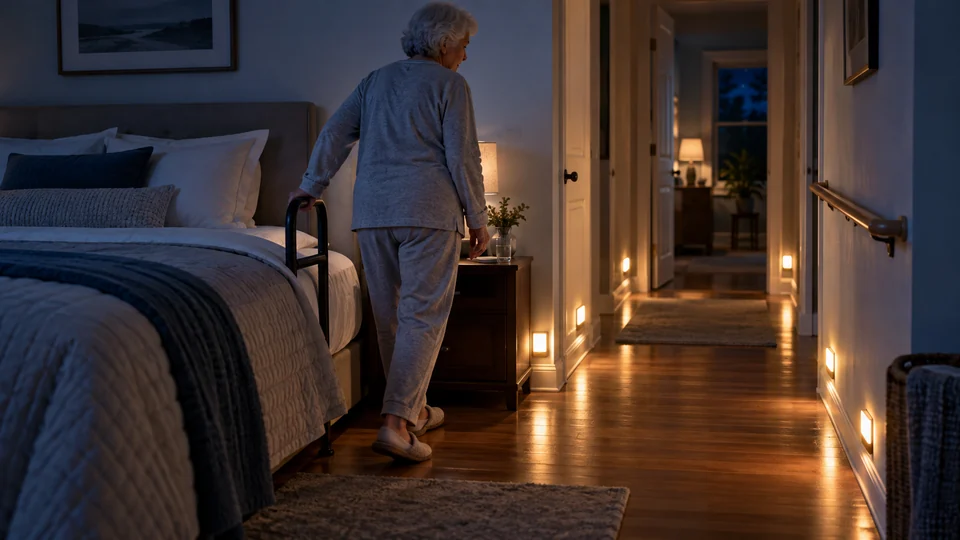

Nighttime can bring several fall risks together for older adults. A person may wake from sleep, sit up in a dark room, stand before feeling fully steady, and begin walking toward the bathroom within a matter of seconds. Poor lighting, dizziness, weak legs, medication effects, urinary urgency, an inaccessible mobility aid, or an obstacle in the path can turn that ordinary trip into a fall risk.
Learning how to prevent nighttime falls in seniors therefore involves more than adding a night light or changing the bed. The entire nighttime sequence matters: getting out of bed, becoming steady after standing, walking through the bedroom or hallway, using the bathroom, and returning safely to bed.
Quick Answer
To help reduce nighttime fall risk, start by identifying when the person becomes unstable. Improve lighting before the person stands, keep the route clear, place prescribed mobility aids where they can be accessed safely, review the bed and bedside setup, and consider whether dizziness, weakness, vision problems, medications, cognition, or frequent nighttime urination are contributing.
Do not assume that one product will solve every nighttime fall problem. A person who becomes dizzy immediately after standing needs a different response from someone who trips over an obstacle on the way to the bathroom or has difficulty transferring from the toilet.
Why Nighttime Can Increase Fall Risk
Several challenges can occur at the same time during the night. The person may be sleepy, the room may be dark, vision may not yet be fully adapted to the available light, and the need to use the bathroom may create a sense of urgency.
At the same time, an older adult may already have factors that affect mobility, including:
- Reduced leg strength
- Balance or gait problems
- Dizziness during position changes
- Medication effects
- Reduced vision
- Pain or joint stiffness
- Cognitive impairment or nighttime confusion
- Use of a walker, cane, or other mobility aid
- Recent illness, surgery, or hospitalization
The result is often not one isolated hazard but a sequence of small challenges occurring during the same trip.
Identify Where the Nighttime Problem Happens
Before changing the bedroom or buying equipment, identify the point at which the person becomes unstable.
| Stage | Factors to Review |
|---|---|
| Getting out of bed | Bed height, mattress stability, leg strength, sitting balance, transfer technique, and available supports |
| Immediately after standing | Dizziness, blood pressure changes, medication effects, balance, and weakness |
| First few steps | Mobility aid placement, footwear, lighting, gait, and floor hazards |
| Walking to the bathroom | Urgency, route length, lighting, clutter, thresholds, rugs, and mobility |
| Using the bathroom | Toilet transfers, grab bars, floor surfaces, space for mobility aids, and assistance needs |
| Returning to bed | Fatigue, lighting, orientation, mobility, bed approach, and ability to sit down with control |
Breaking the trip into stages makes it easier to address the actual problem rather than applying the same solution to every nighttime fall risk.
Start With the Bed Transfer
For many people, the first challenge occurs before they have taken a single step. Moving from lying to sitting, positioning the feet, standing, becoming steady, and reaching a mobility aid all form part of the bed-exit sequence.
Watch for:
- Difficulty sitting upright
- Sliding toward the edge of the mattress
- Repeated attempts to stand
- Using excessive momentum
- Pulling on unstable furniture
- Difficulty placing the feet securely
- Loss of balance immediately after standing
- A walker or cane positioned too far away
If the problem is concentrated around getting into or out of bed, our guide to preventing falls from bed for seniors looks more closely at bed transfers, bed height, dizziness, mobility, and other bed-related fall mechanisms.
Make Sure Light Is Available Before Standing
A person should ideally be able to illuminate the immediate bedside area before beginning to walk.
Depending on the room and the person’s abilities, useful options may include:
- A bedside lamp that is easy to reach and operate
- Night lighting along the walking route
- Motion-activated lighting in appropriate locations
- Lighting near the bathroom entrance
- Switches or controls that do not require walking through darkness to reach them
The goal is not necessarily to make the bedroom extremely bright. It is to provide enough useful illumination to identify the mattress edge, floor, footwear, mobility aid, furniture, doorway, and walking route.
Check for Glare, Shadows, and Poor Contrast
More light is not always the same as better visibility. A poorly positioned light can create glare, while uneven illumination can leave dark areas along the walking route.
Walk the nighttime route using the lighting the person actually uses. Look for:
- Dark sections of the floor
- Strong glare from exposed bulbs
- Shadows that make floor changes difficult to interpret
- Doorways or thresholds that are difficult to distinguish
- Furniture that blends into the surrounding floor or wall
Lighting should reflect the person’s vision rather than what seems adequate to someone else.
Clear the Bed-to-Bathroom Route
The route used at night should be wide enough for the person and any mobility aid they use.
Remove or reposition unnecessary obstacles such as:
- Loose cords
- Shoes
- Bags
- Small tables
- Decorative objects
- Unstable floor coverings
- Furniture that narrows the route
Pay particular attention to items that are harmless during the day but difficult to see after waking at night.
Do Not Rely on Furniture as a Handhold
A nightstand, lightweight chair, rolling table, dresser, or other household furniture may move when a person puts body weight through it.
If someone routinely moves from one piece of furniture to another for support on the way to the bathroom, that pattern may indicate that the mobility or transfer setup needs reassessment.
Use appropriate supports rather than assuming nearby furniture can safely function as a grab bar.
Review the Bed and Immediate Bedside Setup
The nighttime route starts at the bed, so the sleeping surface and immediate surroundings deserve attention.
Consider:
- Whether the bed is stable
- Whether the mattress shifts unexpectedly
- Whether the person can sit securely at the edge
- Whether the bed height supports the person’s transfer ability
- Whether loose bedding interferes with movement
- Whether lighting can be reached before standing
- Whether a prescribed mobility aid can be accessed safely
- Whether the preferred exit side is clear
For a more detailed review of these factors, see our guide on how to make a bed safer for seniors.
Do Not Assume a Lower Bed Is Always Safer
A lower bed may reduce the distance of a possible fall in some circumstances, but lowering the sleeping surface can make standing more difficult for someone with weak legs, joint pain, or limited mobility.
The more useful question is whether the person can sit securely, position the feet appropriately, stand with control, and return to sitting safely.
Bed height should therefore be matched to the person’s transfer ability rather than lowered automatically as a nighttime fall-prevention measure.
Watch for Dizziness After Standing
A person may complete the bed transfer successfully and then become lightheaded immediately after standing.
Dizziness at this point can be associated with several possible causes, including changes in blood pressure, medication effects, reduced blood volume, cardiovascular conditions, autonomic problems, or other medical issues.
If dizziness repeatedly occurs when the person gets up at night, it deserves attention rather than being dismissed as normal aging.
Our guide to why seniors feel dizzy when standing up explains orthostatic hypotension and other possible causes in more detail.
Do Not Rush From Lying Down to Walking
Someone who experiences instability during position changes may need to make the transition in stages according to their individualized care or rehabilitation plan.
That can mean moving from lying to sitting, becoming steady, then standing before beginning to walk rather than treating the entire sequence as one movement.
There is no universal number of seconds that every older adult should sit before standing. Follow any individualized recommendations provided by the person’s healthcare or rehabilitation team.
Keep Mobility Aids Accessible
If a walker, cane, or another mobility aid is prescribed, consider where it is positioned while the person is in bed.
The aid should be accessible when needed without requiring unsupported walking, but it should not block the transfer or create another obstacle.
Also check whether the device:
- Is correctly fitted
- Is in good condition
- Can move through the nighttime route
- Fits through relevant doorways
- Can be used safely in the bathroom
A physical therapist can assess the type, fit, and use of a mobility aid when there is uncertainty.
Use Appropriate Footwear
Footwear does not correct dizziness or poor balance, but it can affect whether an unstable step becomes a slip.
Use secure, well-fitting footwear appropriate for the person’s mobility and floor surface. Avoid footwear that is loose, unstable, difficult to put on safely, or likely to interfere with walking.
The footwear should also be positioned where it can be accessed without requiring the person to bend awkwardly or walk barefoot across the room to retrieve it.
Plan for Nighttime Toileting
Bathroom trips are a common reason for leaving bed at night. The risk can increase when a person feels an urgent need to urinate and begins moving before becoming fully steady.
Instead of focusing only on the bedroom, consider the entire toileting sequence:
- Getting out of bed
- Walking to the bathroom
- Entering the bathroom
- Turning and positioning at the toilet
- Sitting down
- Standing again
- Returning to bed
If nighttime urination is frequent, urgent, or newly worsening, discuss the pattern with an appropriate healthcare professional rather than relying simply on fluid restriction.
Consider Whether a Bedside Commode Is Appropriate
For someone who has substantial difficulty reaching the bathroom safely, a bedside commode may be considered as part of an individualized plan.
It is not automatically the right solution for everyone. Consider:
- Whether the person can transfer to it safely
- Whether there is enough space around it
- Whether it is stable on the floor
- Whether caregiver assistance is required
- Whether the person can manage clothing safely
- Whether the equipment can be kept hygienic
An occupational therapist or another appropriate professional can help determine whether a bedside toileting setup is suitable.
Review Bathroom Transfers
The bathroom introduces additional challenges because it often combines hard surfaces, limited space, transfers, and potential moisture.
Review whether the person can safely:
- Enter and leave the bathroom
- Position a walker or other mobility aid
- Turn in the available space
- Sit on the toilet with control
- Stand from the toilet
- Reach appropriate supports
When grab bars are needed, use products and installation methods intended to provide body-weight support. Towel bars, sinks, lightweight furniture, and other household fixtures should not be assumed to function as grab bars.
Review Medications With a Clinician or Pharmacist
Some medications can contribute to effects relevant to nighttime falls, including dizziness, drowsiness, changes in blood pressure, confusion, blurred vision, or impaired alertness.
This is particularly worth considering when nighttime instability begins after:
- A new medication
- A dose change
- A hospital stay
- Surgery
- A change in the overall medication routine
A clinician or pharmacist can review whether a medication or combination of medications may be contributing and determine whether any change is appropriate.
Do not independently stop a prescribed medication, reduce a dose, or change its timing in an attempt to prevent nighttime falls.
Be Careful With Over-the-Counter Sleep Products
Over-the-counter products should still be included when discussing medication-related fall risk. Some products used for sleep or nighttime symptoms can affect alertness or balance.
If an older adult regularly uses prescription medications, over-the-counter sleep products, or supplements, include them in the medication list reviewed with a clinician or pharmacist.
Address Strength, Balance, and Mobility
Environmental changes can remove hazards, but they cannot fully compensate for significant weakness, poor balance, or difficulty walking.
When these problems contribute to nighttime instability, a physical therapist or other appropriate professional can assess:
- Leg strength
- Sitting and standing balance
- Bed transfers
- Walking
- Turning
- Use of stairs
- Use of a cane or walker
- Overall mobility and endurance
If exercise or rehabilitation is appropriate, the programme should be individualized to the person’s abilities, medical conditions, restrictions, and fall risk.
Consider Vision
Vision affects how well a person identifies the mattress edge, floor, obstacles, thresholds, furniture, and bathroom fixtures.
At night, reduced visual information can make these tasks more difficult.
Consider whether:
- Needed glasses are accessible
- The person can identify the walking route
- Lighting creates excessive glare
- Important changes in floor level are visible
- Recent vision changes need professional evaluation
Do not assume that adding a brighter bulb solves every visibility problem.
Consider Cognition and Nighttime Confusion
Cognitive impairment can affect nighttime safety in several ways. A person may wake disoriented, forget to use a mobility aid, attempt to walk without assistance, or misunderstand equipment around the bed.
Nighttime confusion can also occur during acute illness or after changes in health.
When cognition is a significant concern, the plan should account for the person’s actual nighttime behavior rather than relying only on verbal instructions given during the day.
Do Not Add a Bed Rail Automatically
A bed rail is not a general treatment for nighttime falls. It does not correct dizziness, improve walking balance, illuminate the route to the bathroom, or treat urinary urgency.
Adult portable bed rails may be used for selected purposes, including assistance with repositioning or transfers for appropriate users, but they can also introduce hazards such as entrapment, incompatibility with the bed or mattress, movement of the device, or falls associated with attempting to climb over a rail.
The person’s mobility, cognition, intended use, bed, mattress, and product design all matter.
If a Transfer Handhold Is Appropriate
Some people may benefit from an appropriate handhold as part of an individualized transfer setup. That decision should be based on the transfer problem rather than the assumption that every older adult at risk of falling needs a rail.
If an appropriate transfer handhold has already been recommended or determined to be suitable, our guide to adjustable bed rails for elderly users compares options for different bed setups and transfer needs.
What About Bed-Exit Alarms?
A bed-exit alarm or sensor may alert a caregiver when someone begins to leave the bed, but it does not physically prevent a fall.
Its usefulness depends on factors such as:
- Why the person is getting up
- How quickly assistance is needed
- Whether an appropriate caregiver can respond
- Whether repeated alarms create confusion or alarm fatigue
Monitoring technology should therefore be considered an additional tool rather than a substitute for addressing mobility, environmental, medical, or toileting factors.
What About Medical Alert Systems?
A personal alert device may help someone summon assistance after a fall or during another emergency, particularly when living alone.
However, an alert system does not prevent the event itself. Consider whether the person can wear or reach the device consistently, understand how to activate it, and use it under stressful circumstances.
Automatic fall-detection features can add another layer of monitoring, but no system should be assumed to detect every fall.
Use Technology to Simplify the Environment
Simple technology may be useful when it removes a specific nighttime obstacle.
Examples include:
- Motion-activated pathway lighting
- Lighting controls that can be operated from bed
- Voice-controlled lighting for someone able to use it reliably
- Personal alert devices
Choose technology based on the person’s abilities and routine rather than adding devices that make the nighttime environment more complicated.
Nighttime Safety for Seniors Who Live Alone
Living alone does not automatically make nighttime movement unsafe, but the absence of immediate assistance changes the consequences of a fall or sudden medical problem.
Consider whether the person can:
- Get into and out of bed independently
- Use the bathroom safely
- Access prescribed mobility aids
- Reach a phone or alert system
- Get help if a fall occurs
- Follow the nighttime plan consistently
If abilities change after illness, hospitalization, surgery, or a new fall, the level of support may need to be reassessed.
When a Recent Hospital Stay Changes the Nighttime Routine
A person returning home after hospitalization may be weaker, more fatigued, or using different medications and mobility equipment than before.
A nighttime routine that was safe before admission may therefore no longer match the person’s current abilities.
Before returning immediately to the previous routine, reassess:
- Bed transfers
- Walking to the bathroom
- Use of stairs
- Mobility aids
- Medication-related symptoms
- Nighttime assistance needs
Caregiver Strategies
Caregivers can help by focusing on the specific part of the nighttime sequence that causes difficulty.
Useful strategies include:
- Observing how the person actually gets out of bed
- Knowing when supervision or physical assistance is needed
- Keeping prescribed mobility aids accessible
- Maintaining a clear nighttime route
- Watching for new dizziness, weakness, confusion, or pain
- Recording meaningful falls and near-falls
- Reporting important changes to the appropriate healthcare professional
If a caregiver provides hands-on transfer assistance, appropriate training can help protect both people involved.
Common Mistakes to Avoid
- Focusing only on the bed: many nighttime falls occur after the person has already stood and begun walking.
- Assuming brighter is always better: glare and uneven lighting can still make navigation difficult.
- Leaving a walker across the room: a needed mobility aid should not require unsupported walking to retrieve.
- Using furniture as a grab bar: household furniture may move when body weight is applied.
- Automatically lowering the bed: a lower surface can make standing more difficult for some people.
- Adding a bed rail without identifying the problem: a rail does not solve every nighttime fall mechanism and can introduce additional hazards.
- Restricting fluids simply to avoid bathroom trips: frequent nocturia should be considered in the context of the person’s health rather than addressed only through fluid restriction.
- Changing medication timing independently: medication changes should be made by an appropriate healthcare professional.
- Ignoring repeated dizziness: recurrent lightheadedness after standing deserves assessment.
- Waiting for a serious fall before reassessing: meaningful near-falls can also reveal problems in the current setup.
When Professional Assessment May Be Needed
Professional input may be useful when there are:
- Repeated falls or near-falls
- A fall that causes significant injury
- New or worsening balance problems
- Repeated dizziness or near-fainting
- New weakness or difficulty walking
- Changes in cognition or nighttime behavior
- Difficulty getting into or out of bed
- Frequent nighttime urination that substantially affects safe mobility
- Uncertainty about mobility aids or transfer equipment
- A recent hospitalization or surgery followed by reduced mobility
Physical Therapist
A physical therapist can assess gait, balance, strength, transfers, and the use of mobility aids.
Occupational Therapist
An occupational therapist can evaluate how the person moves through the bedroom and bathroom, recommend environmental changes or equipment, and consider how daily routines affect safety.
Clinician or Pharmacist
A clinician or pharmacist can review medical and medication-related contributors such as dizziness, sedation, blood pressure changes, nocturia, or other symptoms relevant to nighttime falls.
When Urgent Medical Attention May Be Needed
Some falls or nighttime symptoms require more immediate medical attention.
Seek appropriate urgent help for concerning features such as:
- Loss of consciousness
- Suspected serious head, hip, neck, or other injury
- Significant bleeding
- Severe or worsening pain after a fall
- Sudden weakness or numbness
- New difficulty speaking
- Sudden major vision changes
- Severe chest pain
- Severe shortness of breath
- New severe confusion or another acute change in condition
If a person has fallen and cannot get up safely, avoid attempting an unsafe lift and obtain appropriate assistance.
A Nighttime Fall-Prevention Checklist
Use this checklist to review the complete nighttime route:
- Can useful lighting be turned on before the person stands?
- Is the bed stable?
- Can the person get into and out of bed using the appropriate technique?
- Is the immediate floor area clear?
- Is prescribed footwear accessible?
- Is the prescribed walker, cane, or other mobility aid positioned appropriately?
- Is the route to the bathroom free of unnecessary obstacles?
- Are floor coverings stable?
- Can the person identify doorways and changes in floor level?
- Can the bathroom be entered with the mobility aid if one is used?
- Are appropriate supports available for toilet transfers?
- Has repeated nighttime dizziness been evaluated?
- Have relevant medications been reviewed?
- Has frequent or urgent nighttime urination been discussed when necessary?
- Does the person know how to summon help?
- Does the current level of caregiver assistance match the person’s abilities?
For a broader review beyond nighttime movement, our fall prevention checklist for seniors covers additional home, mobility, health, and daily-routine factors.
Frequently Asked Questions
Why do seniors fall more often at night?
Nighttime can combine several challenges at once, including sleepiness, reduced lighting, bathroom urgency, dizziness after standing, poor balance, medication effects, vision problems, and environmental hazards. The specific combination differs from person to person.
What is the first thing to change to prevent nighttime falls?
Start by identifying where the person becomes unstable. If the route is dark or cluttered, lighting and obstacle removal may be immediate priorities. If the person becomes dizzy immediately after standing or cannot transfer safely, the medical or mobility issue may require more attention than the walking route itself.
Should a night light stay on all night?
The goal is to make useful lighting available when the person needs to move. The appropriate setup depends on the room and the individual. Some people may use continuous low-level lighting, while others may prefer motion-activated lighting or a bedside control that can be operated before standing.
Should seniors use a bed rail at night?
Not automatically. Adult portable bed rails may be appropriate for selected users and purposes, but they can also create hazards including entrapment and falls associated with climbing over a rail. The person’s mobility, cognition, intended use, bed, mattress, device, and installation all need to be considered.
Can dizziness cause nighttime falls?
Yes. A person who becomes lightheaded after moving from lying or sitting to standing may be unstable before taking the first step. Repeated dizziness should be evaluated because possible causes include orthostatic blood pressure changes, medication effects, reduced blood volume, cardiovascular conditions, and other medical issues.
Should seniors drink less before bed to avoid bathroom trips?
Fluid restriction should not be used as a universal nighttime fall-prevention strategy. Frequent or urgent nighttime urination may have several causes, and fluid needs vary according to health conditions and medications. Discuss persistent nocturia with an appropriate healthcare professional.
Is a bedside commode safer than walking to the bathroom?
It depends on the individual. A bedside commode reduces walking distance, but the person still needs to transfer to and from it safely. Space, stability, cognition, mobility, clothing management, caregiver assistance, and hygiene all matter. An occupational therapist or another appropriate professional can help determine whether it fits the person’s needs.
Can medication increase nighttime fall risk?
Some medications can contribute to effects such as dizziness, drowsiness, changes in blood pressure, confusion, or impaired alertness. A clinician or pharmacist can review the complete medication list and determine whether any medication-related change is appropriate.
What should I do if a senior nearly falls at night but catches themselves?
A near-fall can provide useful information even when no injury occurs. Consider where it happened, what the person was doing, whether dizziness or urgency was involved, whether the mobility aid was being used, and whether an environmental hazard contributed. Repeated or concerning near-falls should prompt reassessment.
What if the person refuses to use a walker at night?
Try to understand why. The device may be uncomfortable, poorly positioned, difficult to maneuver in the room, or perceived as unnecessary. A physical or occupational therapist can assess fit, technique, environmental barriers, and whether the device remains appropriate rather than simply assuming refusal is the only problem.
Conclusion
Preventing nighttime falls in seniors requires looking beyond a single hazard or device. The complete sequence matters: waking, getting out of bed, becoming steady after standing, beginning to walk, reaching and using the bathroom, and returning to bed.
Start by identifying where difficulty occurs. Make useful lighting available before standing, clear the walking route, keep prescribed mobility aids accessible, review the bed and bedside setup, and pay attention to dizziness, medications, vision, cognition, strength, balance, and nighttime toileting.
Equipment such as transfer aids, bed rails, commodes, alarms, and alert systems may have a role for selected users, but each should address a defined need rather than being added automatically. When symptoms, mobility, health, medications, or nighttime behavior change, reassess the plan so that the environment and level of support continue to match the person.