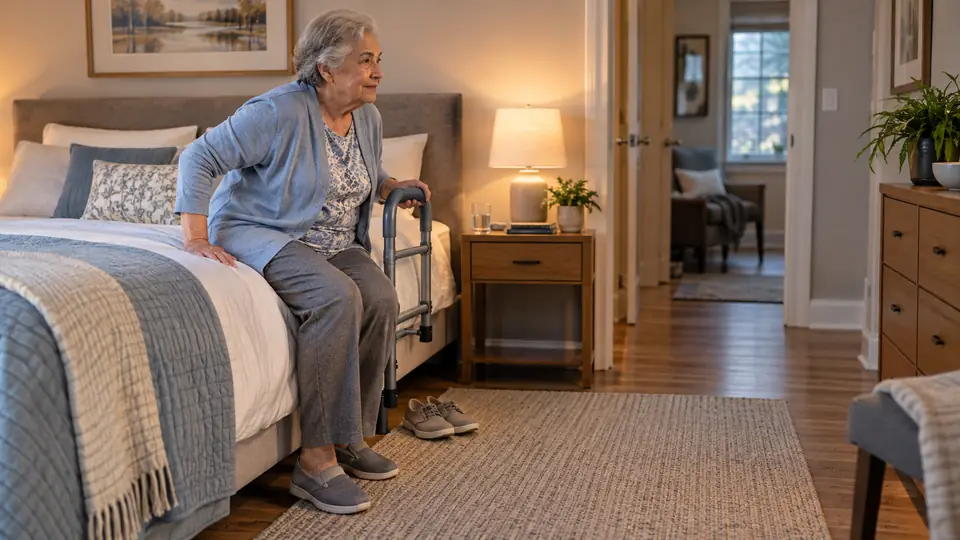

Executive summary on How to Prevent Falls from Bed for Seniors
Falls are common in later life and can be life-changing. Bed-related falls are a distinct subset because they often happen at night, during groggy transitions from lying to standing, or during urgent trips to the bathroom. The bedside environment is a “high-risk micro-zone”: small differences in bed height, lighting, footing, and support points can determine whether a senior transfers safely or ends up on the floor.
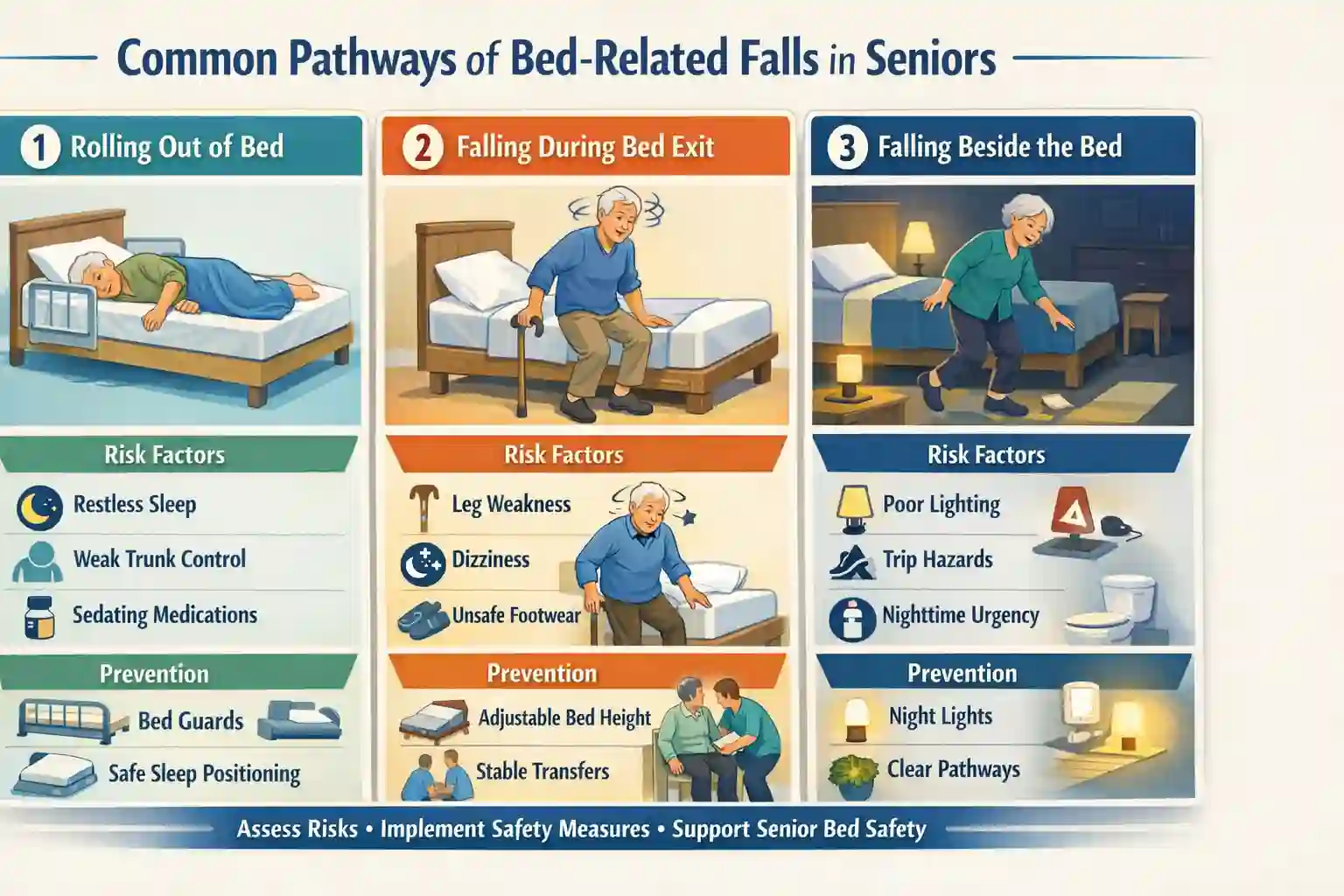
Preventing falls from bed works best when you match interventions to the mechanism of the fall. In practice, most bed-related falls cluster into three pathways:
- Rolling or sliding out of bed during sleep (edge-control problem).
- Losing balance during bed exit or transfers (strength/technique/orthostatic problem).
- Falling in the first steps beside the bed (visibility, clutter, urgency, and gait problem).
Across guidelines and recent research, the strongest preventive pattern is consistent: identify risk drivers, then implement a personalised, multi-component plan that combines environment changes, mobility/strength work, medication optimisation, continence strategies, and, when appropriate, carefully selected assistive devices. Devices such as bed rails and bed guards can help some older adults; for others, they can introduce entrapment or climbing hazards. Device selection must therefore be treated like a safety-critical decision, not a default purchase.
This report provides a practical, evidence-informed framework for caregivers, family members, healthcare professionals, and older adults. It includes risk factors, screening questions, assessment tools, home modifications, device comparison tables, medication and toileting considerations, physiotherapy-oriented approaches, caregiver transfer training, an implementation checklist, a care-plan template, legal and ethical notes on consent and restraint, cost considerations, and short case vignettes illustrating how real-world plans come together. Guidance may vary by jurisdiction, particularly around bed rails and restraint definitions; local regulations and facility policies should be verified before implementation.
Bed-related falls explained and the risk profile that predicts them
A bed fall is rarely “just clumsiness.” It is usually the visible outcome of interacting risks: age-related changes such as reduced strength, balance, or vision; medical contributors such as orthostatic symptoms or cognitive impairment; medication effects such as sedation or blood pressure changes; and an environment that does not support safe transfers at night.
Mechanism matters because it determines the best intervention mix. The same device can be protective in one scenario and harmful in another. For example, a rail that helps a cognitively intact senior stabilise during sit-to-stand may increase risk for a confused senior who attempts to climb over it.
Common pathways and their typical drivers
Rolling or sliding out during sleep tends to be driven by reduced trunk control, restless sleep, sedating medications, pain-related repositioning, a narrow sleep surface, or a habit of sleeping near the bed edge. Prevention emphasises safe edge control and injury mitigation. In cases where edge control is the primary issue, properly fitted bed guards for seniors may provide additional support when selected carefully.
Falling during bed exit often involves low leg strength, poor transfer technique, dizziness on standing, grabbing unstable furniture, unsafe footwear, or a bed height that does not match the person’s biomechanics. Prevention emphasises height optimisation, staged transitions, and training.
Falling beside the bed often reflects inadequate night lighting, trip hazards, urgency to toilet, gait instability, or using the wrong mobility aid—or not using it. Prevention emphasises lighting, clear pathways, toileting plans, and mobility supports.
Evidence-based risk factors most relevant to bed-related falls
The following risk factors repeatedly appear in contemporary falls guidance and research, and they map directly onto bed-fall mechanisms:
- History of falls or near-falls, especially at night or during transfers. A prior fall is an important indicator of future fall risk.
- Weakness, impaired balance, and gait instability, which may respond to targeted exercise and physiotherapy-style training.
- Orthostatic symptoms such as lightheadedness when sitting or standing up, which should be assessed when bed-exit falls occur.
- Nocturia and urgency, which increase nighttime bed exits and rushing.
- Cognitive impairment, delirium risk, or nighttime confusion, which can increase unsafe attempts to self-transfer and reduce hazard awareness.
- Medication burden and high-risk medication effects, including sedation, dizziness, confusion, and blood pressure changes.
- Environmental hazards, especially poor lighting, clutter, slippery floors, unstable bedside furniture, and an ill-fitting bed system.
Risk factor-to-intervention mapping table
| Risk driver | How it increases bed-fall risk | Prevention emphasis | Common pitfalls |
|---|---|---|---|
| Prior falls / near-falls | Signals an unresolved cause and greater recurrence risk | Post-event review, mechanism-specific plan, close follow-up | “Quick fix” purchases without assessment |
| Weakness / poor balance | Unstable sit-to-stand and first steps | Progressive strength and balance training; transfer practice | Over-reliance on rails instead of addressing mobility |
| Orthostatic symptoms | Dizziness on standing can lead to loss of balance or collapse | Staged transitions; clinical assessment; medication and hydration review where appropriate | Standing too quickly or rushing to the toilet |
| Nocturia / urgency | More nighttime transfers and hurried walking | Toileting plan, night lighting, bedside commode if appropriate | Addressing sleep without considering the reason for repeated bed exits |
| Cognitive impairment | Unsafe self-transfers or attempts to climb barriers | Supervision strategies, low-bed considerations, simple cues | Barriers that increase climbing or entrapment risk |
| Medication effects | Sedation, impaired balance, confusion, or hypotension | Medication review and adjustment where clinically appropriate | Changing medications without professional guidance |
| Environment / bed system | Trips, slips, poor support points, or unsafe gaps | Lighting, flooring, bed height, and safe device fit | Unchecked rail-mattress gaps or returning clutter |
Assessment and screening workflow for caregivers and clinicians
A rigorous prevention plan starts with a structured assessment. In practice, assessment should be quick enough to begin immediately after a fall or near-fall but thorough enough to identify modifiable causes. The goal is to clarify what happened, why it happened, and what can change.
Rapid bedside screening questions
These questions can help family caregivers, home-care staff, nurses, and clinicians identify the likely fall pathway and recognise conditions that warrant further evaluation.
Event pattern and mechanism
- What time did the incident occur: early night, middle of the night, or early morning?
- Was the person trying to get out of bed, already walking, or asleep and rolled out?
- Was it a true fall, a slide, or a near-fall caught by furniture or another person?
Symptoms that suggest medical contributors
- Did they feel dizzy or lightheaded when sitting up or standing?
- Did they black out or lose awareness, even briefly?
- Have there been new symptoms such as signs of infection, dehydration, confusion, or weakness?
Continence and nightly routines
- How often do they get up to urinate at night?
- Do they rush because of urgency?
- Is there leakage that prompts hurried bed exits?
Mobility and function
- Can they roll and sit up without pulling hard on a rail or furniture?
- Can they sit upright at the edge of the bed for 30–60 seconds without significant instability?
- Do they need to use their arms heavily to stand?
- Is their walker or cane within easy reach before the first step?
Environment and device fit
- Is there adequate light from the bed to the bathroom?
- Are there throw rugs, cords, or clutter near the bed?
- Is the bed height appropriate for safe sit-to-stand?
- Is any bed rail or guard fitted securely, without dangerous gaps?
Practical assessment tools that fit real workflows
Community and outpatient settings may benefit from brief functional tests and structured care pathways because they translate risk into observable performance. In institutional settings, structured fall-risk tools are widely used but should not replace clinical judgement or a mechanism-specific plan.
Assessment tool comparison table
| Tool or method | Who can use it | What it tells you | Why it matters for bed falls |
|---|---|---|---|
| Structured falls pathway | Clinicians; some home-care programmes | Risk identification and targeted interventions | Discourages device-first decisions without understanding the cause |
| Timed mobility test, such as a Timed Up and Go-style assessment | Clinicians; trained staff | Mobility, turning stability, and transfer performance | Can identify instability relevant to bed exit and early steps |
| Chair-stand style test | Clinicians; trained staff | Lower-limb strength and endurance | Directly relevant to standing from the bed edge |
| Standing balance assessment | Clinicians; trained staff | Balance capacity and postural control | Helps identify instability relevant to nighttime walking |
| Orthostatic vital sign assessment | Clinicians; trained staff | Blood pressure and heart-rate response to position changes | May help clarify dizziness-related bed-exit falls |
| Medication review | Clinicians; pharmacists | Potential sedation, hypotension, and interaction burden | Identifies potentially modifiable contributors |
| Environmental hazard walk-through | OT; caregiver using an appropriate checklist | Lighting, trip hazards, and support points | Targets hazards beside the bed and on the route to the bathroom |
When to escalate beyond home-based screening
Certain features suggest the need for prompt medical evaluation rather than relying only on environmental changes:
- A fall with head impact, especially when the person takes anticoagulant medication or develops new neurological symptoms
- Syncope or suspected fainting
- New delirium or significant behavioural change
- Sudden new inability to stand or walk
- Recurrent bed-exit falls despite immediate safety changes
A useful principle for caregivers is that every fall provides information. Document the time, location, symptoms, footwear, lighting, device use, and toileting context. Patterns may reveal the most important driver and help guide the next intervention.
Prevention strategies that address causes, not just symptoms
Effective bed-fall prevention is layered: the goal is both to reduce the likelihood of a fall and to reduce harm if one occurs. A comprehensive strategy may combine environmental optimisation, careful device selection, clinical review, and improvements in strength, balance, and transfer technique.
Environmental and home modifications around the bed
Bedside changes can often be made quickly and address the period when many bed-related falls occur: nighttime bed exit.
Bed height and stability
- Aim for a bed height that allows the senior to sit securely at the edge, place both feet on the floor, and rise without excessive momentum. Individual mobility and clinical needs should guide the final height.
- Ensure the bed frame is stable and the mattress does not slide. Lock wheels where applicable.
- If using an adjustable bed, confirm that the mattress and any rail or guard remain properly aligned as the bed position changes.
Lighting and visual cues
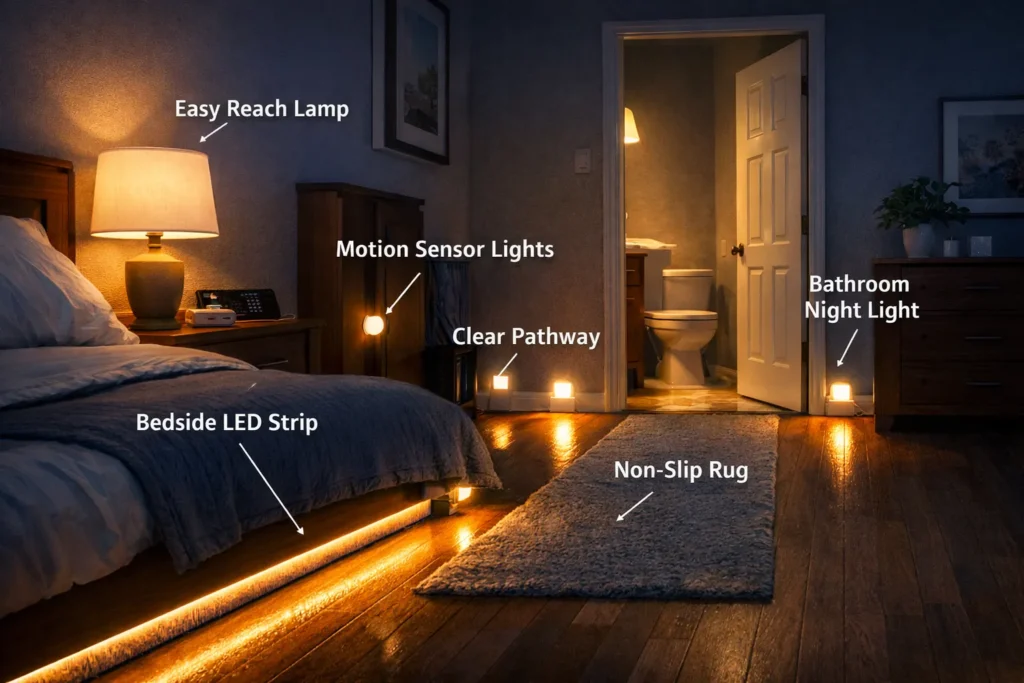
- Provide low-level lighting between the bed and bathroom so the person does not have to navigate a completely dark room.
- Motion-sensor or dusk-to-dawn lights may be useful where they provide adequate visibility without creating excessive glare.
- Keep a bedside lamp or accessible light control within easy reach.
Flooring and the first-steps zone
- Clear the floor beside the bed and along the route to the bathroom.
- Remove unsecured throw rugs or secure them appropriately.
- Route cords away from walking paths.
- Choose well-fitting footwear rather than loose slippers that may increase tripping risk.
Bedside aids placement
- Place glasses, a phone, hydration, and any call device within reach.
- Position the walker or cane so it can be reached before the person begins walking.
- Do not rely on unstable bedside furniture as a substitute for an appropriate mobility or transfer aid.
Assistive devices: pros, cons, and selection criteria
Assistive devices can serve several different purposes:
- Support transfers with devices such as assist handles, transfer poles, or other transfer aids.
- Limit roll-out risk with appropriately selected guards, bumpers, or rails.
- Alert caregivers through alarms, sensors, or monitoring systems where a dependable response is available.
A rigorous approach treats devices as risk-matching tools. The right device is the one that addresses the dominant problem without introducing a higher-risk failure mode.
For older adults who need a stable handhold for bed entry, exit, or repositioning, an adjustable rail may be worth considering when it is compatible with the bed and mattress and does not introduce unsafe gaps. Our guide to adjustable bed rails for elderly users compares different designs, adjustment ranges, and support features to help narrow the options.
Device comparison table
| Device type | Primary use | Potential advantages | Limitations / risks | Selection considerations |
|---|---|---|---|---|
| Bed assist handle / mobility rail | Transfer support for repositioning, sitting up, or standing | Provides a defined handhold and may support independence for suitable users | Incorrect fit can allow movement or hazardous gaps; may create false confidence | Check bed and mattress compatibility, installation requirements, user cognition, and transfer needs |
| Partial or half-length bed rail | Selected roll-out protection and transfer support | May provide a barrier while leaving part of the bed edge accessible | Entrapment or gap hazards can occur if incompatible or incorrectly fitted; some users may attempt to climb over it | Assess the reason for use, cognition, bed compatibility, installation, and ongoing fit |
| Full-length bed rail | Extensive side barrier | Creates a substantial physical barrier along the bed edge | May increase climbing, entrapment, or restraint concerns depending on the user and setting | Requires careful individual assessment and attention to applicable rules and policies |
| Bed guard / foam bumper | Soft edge cue or roll-out protection | Provides a softer boundary than a rigid rail | May shift or reduce usable sleep width; not appropriate for every person or bed | Consider the fall mechanism, product instructions, fit, and whether the device remains securely positioned |
| Low bed | Reducing fall distance in selected situations | Can reduce the distance to the floor if a roll-out occurs | A bed that is too low may make standing more difficult and can affect caregiver ergonomics | Balance injury mitigation against the person’s ability to sit and stand safely |
| Bedside fall mat | Impact mitigation if a fall occurs | Provides a cushioned surface beside the bed | Can itself become a walking or trip hazard depending on placement and design | Consider edge design, placement, walking route, mobility aids, and individual transfer patterns |
| Bed-exit alarm / pressure pad / motion sensor | Caregiver alerting | May alert caregivers when an at-risk person begins to leave the bed | Does not physically prevent a fall; effectiveness depends on timely response and appropriate use | Use only as part of a broader plan where dependable response is available |
| Transfer pole / floor-to-ceiling grab pole | Transfer stability | Provides a predictable handhold in an appropriate location | Requires suitable installation and may not be compatible with every room or ceiling | Consider structural suitability, placement, transfer pattern, and professional assessment where needed |
| Sit-to-stand / transfer aid | Assisted transfer for selected users | Can support structured transfers and reduce manual handling demands in appropriate circumstances | Requires appropriate user selection, equipment knowledge, and training | Professional assessment is often appropriate when significant transfer assistance is required |
Selection rules that help prevent common mistakes
- If the senior has nighttime confusion, delirium risk, or a history of climbing, consider whether low-bed strategies, lighting, supervision, and toileting support address the problem more appropriately than a barrier that could increase climbing risk.
- If the main problem is unsafe standing from bed, focus on transfer support, mobility assessment, and technique rather than assuming a containment device is needed.
- Any rail or guard should be installed and used according to its instructions, with attention to compatibility and potentially hazardous gaps. Reassess the setup after mattress replacement, bed adjustments, or changes in the user’s condition.
Medication review, sleep support, and continence management
Bed-fall prevention should also address clinical factors that can become especially important at night.
Medication review
- Discuss medications that may contribute to nighttime sedation, dizziness, confusion, or unsteady gait with an appropriate healthcare professional.
- Pay particular attention to recently added medications or dose changes when a new pattern of falls or near-falls appears.
- A clinician or pharmacist can assess medication combinations and determine whether changes are appropriate.
Sleep management without increasing fall risk
- Do not assume that increasing sedation is the solution to nighttime restlessness, particularly when falls or confusion are already concerns.
- Consider non-drug sleep supports such as a consistent routine, appropriate daytime activity, pain management, and suitable light exposure.
- Questions about sleep medication should be discussed with the prescribing clinician rather than adjusted independently.
Continence and nocturia
Nighttime bathroom trips create repeated opportunities for bed-exit and walking-related falls. Depending on the individual situation, useful measures may include:
- Establishing a regular bedtime toileting routine.
- Discussing persistent or worsening nocturia and urgency with a healthcare professional.
- Reviewing medication timing, including diuretics, with the prescribing clinician where appropriate.
- Considering whether a bedside commode or urinal could reduce hurried nighttime walking for an appropriate user.
Mobility, strength, balance, and physiotherapy-oriented approaches
Exercise and mobility interventions are an important part of broader fall-prevention strategies for many older adults. For bed-related falls, general balance and strength work can be combined with task-specific practice where appropriate.
Movement skills relevant to safer bed exit include:
- Rolling and repositioning without unintentionally moving toward the bed edge
- Controlled movement from lying to sitting
- Stable sitting at the bed edge
- Controlled sit-to-stand technique
- First-step control and turning
- Appropriate use of a walker, cane, or other prescribed mobility aid
A practical programme may include:
- Progressive lower-limb strengthening appropriate to the person’s ability
- Balance exercises selected for the individual’s level of stability
- Gait practice with the mobility aid used in everyday life
- Transfer practice in a realistic environment where appropriate and safely supervised
Older adults with significant weakness, recurrent falls, major balance problems, or difficulty transferring may benefit from physiotherapy or occupational therapy assessment so that exercises, equipment, and transfer strategies can be matched to their abilities.
Intervention pros and cons
| Intervention domain | Potential benefits | Trade-offs / limitations | Particularly relevant when |
|---|---|---|---|
| Environment | Can remove immediate hazards and improve nighttime visibility | Requires ongoing attention because clutter and room arrangements change | Poor lighting, clutter, unsuitable bed height, or unstable support points are present |
| Exercise and transfer training | Addresses functional contributors and may support independence | Requires participation, time, and sometimes professional supervision | Weakness, balance problems, or transfer instability are present |
| Medication optimisation | May address medication-related sedation, dizziness, or blood pressure effects | Requires professional review; some medications require careful tapering or cannot simply be discontinued | Symptoms coincide with medication use or recent changes |
| Continence / nocturia plan | May reduce rushed nighttime movement | Persistent symptoms may require medical evaluation | Frequent nighttime bathroom trips or urgency contribute to falls |
| Assistive devices | Can address a specific transfer, edge-control, or monitoring need | Poor selection or installation can introduce new hazards | There is a clearly identified need and a compatible device |
| Monitoring / alarms | May help caregivers respond to attempted bed exits | Does not address the underlying cause and depends on a timely response | A reliable caregiver response system is available |
Caregiver training and implementation tools
Prevention ultimately succeeds or fails at the bedside. Even well-chosen equipment may not help if transfers are rushed, the walker is out of reach, or lighting is not used consistently. Caregivers need a simple approach that supports both the older adult and the person assisting them.
Safe transfer technique principles for bed exit
A safer approach prioritises preparation, staged transitions, and appropriate support without pulling on unstable furniture or using unsafe manual-handling techniques.
Preparation
- Clear the route and turn on appropriate lighting.
- Make suitable footwear available.
- Position the prescribed mobility aid within reach.
- If a wheelchair is being used, follow appropriate transfer procedures and ensure it is positioned and secured correctly.
Staged transition
- Move from lying to sitting in a controlled manner.
- Pause at the bed edge before standing, particularly if dizziness is a concern.
- Stand using the transfer technique recommended for the individual.
- Establish balance before beginning to walk.
Use appropriate support
- Use transfer equipment only when it is appropriate for the individual and caregivers have been trained to use it.
- Avoid pulling the person by the arms or allowing them to depend on unstable furniture.
- Do not encourage climbing over a rail. The care plan should include a safe method for bed exit.
Implementation checklist (bed-focused)
| Item | Owner | Suggested review point | Notes |
|---|---|---|---|
| Document mechanism and timing of events | Caregiver / clinician | After each fall or near-fall | Include dizziness, urgency, lighting, and footwear |
| Review bed height and stability | Caregiver / OT / PT as appropriate | After setup changes or changes in mobility | Recheck after mattress or bed changes |
| Check nighttime lighting | Family / caregiver | As part of the bedtime routine | Ensure the walking route is visible without excessive glare |
| Remove floor hazards | Family / caregiver | Regularly | Watch for rugs, cords, clutter, and changes in furniture placement |
| Position mobility aid appropriately | Caregiver / user | Each night where relevant | Make placement part of the bedtime routine |
| Medication review | Clinician / pharmacist | After relevant medication changes or when clinically indicated | Discuss sedation, dizziness, confusion, and blood pressure effects |
| Review toileting strategy | Caregiver / clinician | When nighttime urgency or frequent bed exits are present | Persistent nocturia or urgency may warrant clinical assessment |
| Check rail, guard, or handle installation | Caregiver / responsible user | According to product instructions and after bed changes | Look for loosening, movement, incompatibility, or hazardous gaps |
| Review mobility and transfer plan | Senior + PT / OT / caregiver as appropriate | When ability, confidence, or fall pattern changes | Update assistance level and equipment as needed |
Individualised care plan template
| Section | What to record | Why it matters |
|---|---|---|
| Fall mechanism | Roll-out, bed exit, bedside walking, time of day, and circumstances | Helps determine which interventions are relevant |
| Priority risk drivers | Urgency, dizziness, weakness, confusion, medications, environment | Focuses attention on modifiable contributors |
| Environment plan | Bed height, lighting, flooring, and placement of mobility aids | Reduces exposure to bedside hazards |
| Device plan | Device selected, reason for use, installation requirements, and review plan | Helps prevent device-related hazards |
| Mobility plan | Exercises, transfer strategy, mobility aids, and supervision needs | Addresses functional contributors |
| Clinical plan | Medication review, orthostatic symptoms, continence concerns, and other medical contributors | Ensures medical causes are not overlooked |
| Consent and documentation | Preferences, consent, decision-making considerations, and applicable care policies | Supports autonomy and appropriate use of restrictive interventions |
| Outcome tracking | Falls, near-falls, confidence, nighttime awakenings, and changes in function | Shows whether the plan needs adjustment |
Case vignettes (composite examples)
Vignette A: Nighttime urgency plus dizziness. An 80-year-old who wakes several times at night to urinate reports a near-fall after standing from bed. The prevention plan focuses on a well-lit route, reducing the need to rush, and pausing after sitting up before standing. A healthcare professional evaluates the reported dizziness and reviews relevant medications. Because the main problem is bed exit rather than rolling from the mattress, any transfer-support device would be selected only after confirming that it matches the person’s needs and is compatible with the bed.
Vignette B: Rolling out during sleep after a medication change. An 84-year-old rolls from bed twice within a short period after a change in nighttime medication. Because the events occur during sleep rather than while attempting to stand, the plan focuses on reviewing possible medication effects, assessing bed height, and considering appropriate edge-control or injury-mitigation strategies. Any guard, bumper, or mat would need to be evaluated for fit and for hazards it might introduce.
Vignette C: Cognitive impairment and repeated unassisted bed exits. A long-term care resident repeatedly attempts to leave bed without assistance. Rather than assuming that a full rail is the safest solution, the care team considers the possibility of climbing and entrapment. The plan may instead emphasise scheduled toileting, observation during higher-risk periods, environmental cues, an appropriate bed setup, and monitoring consistent with the resident’s care needs and local policies.
Ethics, consent, cost, and sourcing considerations
Ethical and legal considerations: restraint risk, autonomy, and consent
Bed-fall prevention operates on a safety-autonomy continuum. Some interventions, especially barriers that prevent a person from freely leaving the bed, may be treated as restraints depending on how they are used and the rules that apply in a particular jurisdiction or care setting.
Practical safeguards include:
- Use the least restrictive approach that appropriately addresses the identified risk.
- Include the older adult in decisions whenever possible and follow appropriate consent or substitute decision-making processes where required.
- Document why a restrictive intervention is being considered, what alternatives have been evaluated, and how it will be monitored in formal care settings.
- Reassess regularly, because risk can change after illness, medication changes, changes in cognition, or functional decline.
Because legal definitions, facility policies, and professional requirements vary, healthcare organisations and caregivers working in regulated settings should follow the standards applicable to their jurisdiction.
Cost considerations
Fall prevention does not necessarily begin with expensive equipment. Some of the first issues to address are environmental: poor lighting, clutter, an unsuitable bed setup, inaccessible mobility aids, or an unsafe walking route.
A sensible order of priorities is:
- Identify the mechanism behind the fall or near-fall.
- Correct straightforward environmental hazards such as inadequate lighting, clutter, and unstable support points.
- Seek appropriate clinical, physiotherapy, occupational therapy, or pharmacy input when medical or functional factors appear important.
- Add equipment when it addresses a clearly identified need and can be used safely with the existing bed and room setup.
When comparing equipment costs, also consider compatibility, installation, maintenance, and whether the device will remain suitable if the mattress, bed frame, mobility level, or care needs change.
Final Thoughts
Preventing falls from bed for seniors is rarely about finding a single device that solves every problem. A person who rolls from bed during sleep has a different risk pattern from someone who becomes dizzy while standing, and both require a different approach from someone who falls while walking to the bathroom at night. Identifying that mechanism first makes it easier to choose interventions that address the actual cause.
For many older adults, the most useful plan combines several modest changes: better nighttime lighting, a clear walking route, an appropriate bed setup, access to the correct mobility aid, attention to medications and continence issues, and improvements in strength or transfer technique where possible. Bed rails, guards, alarms, and other devices can form part of that plan, but they should be selected for a defined purpose and checked for compatibility and potential hazards rather than treated as automatic solutions.
Fall risk can also change over time. A setup that works well today may need to be reconsidered after an illness, medication change, new mattress, decline in mobility, or change in cognition. Regular reassessment helps keep the prevention plan matched to the person rather than simply leaving equipment in place because it has always been there.