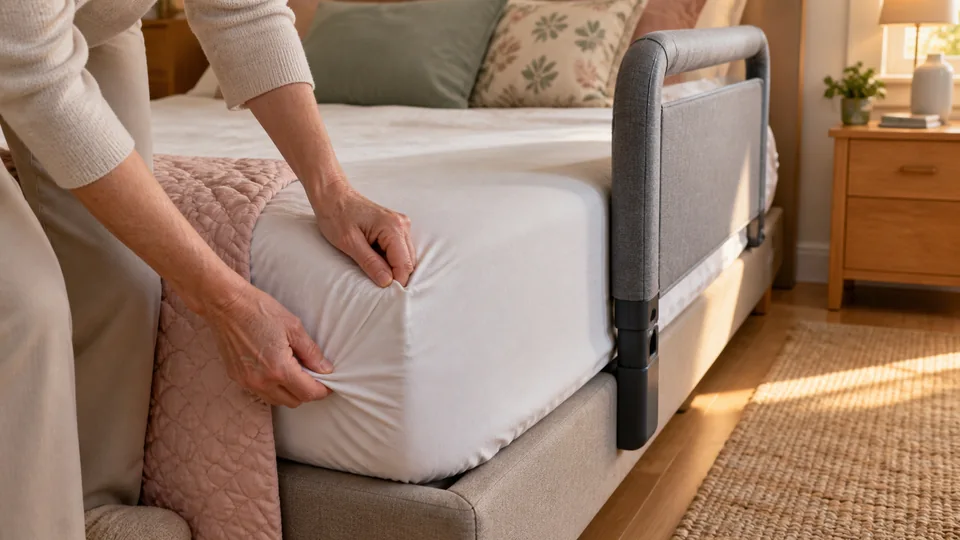

Making a bed safer for an older adult is not simply a matter of adding a rail or lowering the mattress. The safest setup depends on how the person moves in bed, gets up, sits down, and walks away from the bedside. Strength, balance, vision, medications, cognition, bed height, mattress stability, lighting, and the surrounding floor space can all affect the result.
So, how do you make a bed safer for seniors? Start by identifying where the difficulty occurs. Someone who rolls or slides toward the edge during sleep has a different problem from someone who becomes unsteady while standing up. Once the main risk is understood, the bed height, mattress, transfer supports, bedside layout, lighting, and other equipment can be adjusted to match the person’s needs.
Quick Answer
A safer bed for an older adult should make it easier to reposition, sit at the edge, stand, and leave the bedside without introducing new hazards. Useful changes may include:
- Choosing a bed height that works with the person’s transfer ability
- Keeping the bed frame and mattress stable
- Providing adequate bedside and pathway lighting
- Keeping the floor beside the bed clear
- Positioning prescribed mobility aids within safe reach
- Using transfer supports only when they are appropriate for the individual
- Evaluating rolling or sliding from bed separately from transfer problems
- Reviewing medications, vision, strength, balance, and other contributors to falls
For a broader look at the different mechanisms behind nighttime incidents, see our guide on how to prevent falls from bed for seniors.
Start With the Problem You Are Trying to Solve
Before changing the bed, determine what is actually making it unsafe. Different problems require different solutions.
| What Happens? | Possible Factors to Review |
|---|---|
| Rolling or sliding toward the edge during sleep | Sleep movement, mattress position, bed height, medical or cognitive factors, and whether an appropriate edge support is indicated |
| Difficulty sitting at the edge | Trunk control, mattress stability, positioning, bed height, and transfer technique |
| Difficulty standing up | Leg strength, bed height, pain, balance, footwear, transfer technique, and need for an appropriate handhold |
| Dizziness after standing | Blood pressure changes, medications, medical conditions, and the need for clinical assessment |
| Falling during the first few steps | Balance, gait, mobility aids, footwear, lighting, vision, and floor hazards |
| Unsafe nighttime bathroom trips | Urgency, lighting, walking distance, mobility, medications, and bathroom-route hazards |
This distinction matters because adding equipment without identifying the problem can fail to address the actual risk and may sometimes introduce another one.
Review the Bed Height
Bed height affects how much effort and control are required during a transfer. A very low bed can demand more lower-body strength when standing, while a bed that is too high may make it difficult for the person to establish secure foot contact before rising.
There is no single bed height that is ideal for every older adult. Body dimensions, leg strength, joint mobility, transfer technique, footwear, mattress compression, and whether assistance or equipment is used can all affect the appropriate setup.
Rather than relying on a universal knee angle or a fixed measurement, evaluate whether the person can sit securely, position the feet appropriately, stand with control, and sit back down without excessive effort. Our guide to bed height for seniors explains these factors in more detail.
Be Careful About Simply Lowering the Bed
Lowering a sleeping surface may reduce the distance of a potential fall in some situations, but lower is not automatically safer. Someone with weak legs, painful knees or hips, or substantial transfer difficulty may find it harder to stand from a very low surface.
If changing bed height solves one problem while making transfers more difficult, the complete setup needs to be reconsidered.
Make Sure the Bed Itself Is Stable
A person should not have to compensate for a bed that shifts during a transfer. Check the frame, legs, casters, mattress, and other components for unwanted movement.
Depending on the type of bed, useful checks may include:
- Making sure the frame is assembled correctly
- Checking that adjustable components lock or operate as intended
- Locking casters when the bed is designed to be stationary during transfers
- Checking for loose or damaged components
- Making sure the mattress does not shift unexpectedly on its support surface
- Reassessing the setup after changing the mattress, topper, frame, or transfer equipment
A stable bed does not guarantee a safe transfer, but unexpected movement can make an already difficult transfer harder to control.
Consider How the Mattress Affects Transfers
The mattress is part of the transfer surface. Its thickness, edge support, compression, and interaction with the bed frame can affect how a person sits and stands.
A very compressible surface may make some transfers more difficult because the seated position changes as the mattress compresses. On the other hand, mattress selection also involves pressure management, pain, sleep comfort, medical needs, and other factors, so firmness should not be chosen solely for ease of standing.
When a person has substantial mobility limitations or pressure-injury concerns, mattress selection may require professional input rather than a generic recommendation such as “use a firm mattress.”
Keep Bedding Manageable
Sheets and blankets should not create unnecessary obstacles during bed entry and exit. Watch for:
- Loose bedding that repeatedly falls onto the floor
- Blankets that become tangled around the legs
- Mattress pads or toppers that move during transfers
- Items stored at the side of the bed that interfere with foot placement
The goal is not to eliminate comfortable bedding, but to make sure the sleeping setup does not unnecessarily complicate movement.
Make the Bedside Area Easy to See
A safer bed includes the immediate area around it. Someone getting up at night needs to identify the edge of the bed, floor, footwear, mobility aid, and nearby objects before walking.
Useful lighting changes can include:
- A bedside light that can be reached before standing
- Low-level lighting along the route away from the bed
- Motion-activated lighting where appropriate
- Enough illumination to identify floor hazards and changes in level
- Positioning lights to reduce excessive glare and deep shadows
The amount and type of lighting should reflect the person’s vision rather than what appears adequate to someone with normal vision.
Keep the Immediate Floor Area Clear
The first few steps after standing can be especially important for someone with limited strength or balance. Keep the bedside area predictable and free of unnecessary obstacles.
- Keep electrical cords and charging cables away from walking routes.
- Avoid leaving shoes, bags, or other objects beside the bed.
- Address loose or unstable floor coverings.
- Keep frequently used items within safe reach.
- Make sure bedside furniture does not obstruct transfers.
- Keep the preferred exit side of the bed clear when possible.
Changes elsewhere in the bedroom may also matter, but the priority here is the space directly involved in getting into and out of bed.
Position Mobility Aids Where They Can Be Used Safely
If a person has been advised to use a walker, cane, or another mobility aid, consider how that device fits into the bed-exit sequence.
The person should not have to take several unsupported steps simply to retrieve the device. At the same time, a walker or cane placed carelessly beside the bed can itself become an obstacle.
A physical or occupational therapist can help determine appropriate positioning and whether the mobility aid is correctly fitted for the person.
Separate Roll-Out Risk From Transfer Support
“Bed safety” can describe two very different problems:
- Remaining safely on the sleeping surface: for example, someone who rolls or slides toward the edge while asleep.
- Moving into or out of bed: for example, someone who needs a stable handhold during repositioning or standing.
These situations should not automatically be addressed with the same equipment.
If the Main Concern Is Rolling or Sliding From Bed
Start by considering why the person is reaching or crossing the edge. Sleep movement, confusion, medical conditions, bed dimensions, mattress characteristics, and other factors may all matter.
For some people, an appropriately selected guard or rail may form part of the plan, while for others a different approach may be preferable. If you are comparing products specifically for this type of use, our guide to bed guards for seniors covers different designs and the factors to consider before choosing one.
If the Main Concern Is Getting Into or Out of Bed
A person with limited strength or mobility may instead need a handhold for repositioning, sitting up, or transitioning between the bed and standing.
Adult portable bed rails can include products described as assist bars, grab bars, transfer aids, bed canes, and rails. These devices are not appropriate for every person or every bed. Individual suitability, cognition, mobility, mattress and frame compatibility, product design, and installation all matter.
For someone who has been determined to be an appropriate candidate for this type of support, our guide to adjustable bed rails for elderly users compares options intended for different bed configurations and support needs.
Understand the Risks of Adult Portable Bed Rails
Adult portable bed rails should not be treated as an automatic safety upgrade. They can assist some people with movement, transfers, or remaining on the sleeping surface, but they can also create serious hazards.
Potential concerns include:
- Entrapment between the rail and mattress
- Entrapment within or under parts of the rail
- Gaps created when the mattress compresses or moves
- A rail shifting or loosening over time
- Attempting to climb over a rail
- Using a rail that is incompatible with the mattress or bed frame
- Using the rail with a person for whom it is not appropriate
People with confusion, restlessness, altered mental status, poor muscle control, or other physical or cognitive limitations may face additional risks and require particularly careful assessment.
A bed rail should not be used as a restraint or as a substitute for appropriate monitoring.
If an Adult Portable Bed Rail Is Used
When an adult portable bed rail has been determined to be appropriate, treat compatibility and installation as essential parts of the setup.
- Check that the rail is intended for the person’s age, size, weight, and use case.
- Confirm compatibility between the rail, mattress, and bed frame.
- Follow the manufacturer’s installation instructions.
- Install the retention system or safety strap exactly as directed.
- Check for unintended openings or possible entrapment areas.
- Do not modify the rail or improvise an attachment system.
- Do not assume that a different mattress will work with the same installation.
- Inspect the rail regularly for movement, looseness, damage, or changing gaps.
- Reassess the setup if the person’s mobility or cognition changes.
- Check current recalls and safety warnings for the product.
Mattress compression and movement can change the relationship between a rail and the sleeping surface, so an installation that initially appears secure should still be checked over time.
Do Not Assume a Partial Rail Is Automatically Safer
A shorter rail may provide easier access to part of the bed, but rail length by itself does not establish safety. Entrapment risk, placement, retention, openings, compatibility, structural integrity, and the user’s behavior still need to be considered.
Similarly, a longer or more enclosing rail should not automatically be interpreted as providing greater protection. For some users, attempting to climb over a barrier can create another fall hazard.
Choose equipment for a defined purpose rather than according to how much of the mattress edge it covers.
Other Transfer Supports May Be More Appropriate
A portable bed rail is only one type of transfer support. Depending on the person’s abilities and environment, an assessment may consider alternatives such as:
- Bed assist handles
- Transfer poles
- Over-bed trapezes
- Transfer boards
- Slide sheets for assisted repositioning
- Appropriate mobility aids
- Changes to bed height or positioning
- More substantial transfer equipment when required
The appropriate option depends on whether the person can bear weight, use the arms effectively, follow instructions, maintain sitting balance, and perform part or all of the transfer independently.
Think Carefully About Low Beds
A lower bed can reduce the vertical distance associated with a fall, which may be useful in selected situations. However, lowering the bed can also increase the strength and joint movement required to stand.
This trade-off is particularly important for people with:
- Weak legs
- Painful knees or hips
- Limited joint mobility
- Difficulty performing sit-to-stand transfers
- A need for caregiver assistance during transfers
Floor-level sleeping arrangements should therefore not be treated as a universal solution for fall risk. Consider both what happens if the person falls and what happens every time the person needs to stand.
Consider Nighttime Toileting
Many bed-related incidents occur not while the person is sleeping, but when they wake and attempt to reach the bathroom.
When nighttime toileting is part of the risk pattern, review:
- Whether the person can safely stand from the bed
- Whether a walker or other prescribed mobility aid is accessible
- Lighting between the bed and bathroom
- Floor hazards along the route
- Footwear
- Urgency and frequency of nighttime urination
- Whether an appropriately placed bedside commode is indicated
Persistent or changing nighttime urinary symptoms should be discussed with an appropriate healthcare professional rather than addressed only by limiting fluids.
Review Medications When Falls or Dizziness Occur
Some medications can contribute to drowsiness, dizziness, changes in vision, slower reactions, or changes in blood pressure that may increase fall risk. The effect can be particularly noticeable during nighttime transfers.
If falls, near-falls, dizziness, or unusual sleepiness begin or worsen after medication changes, discuss the symptoms with a clinician or pharmacist. Do not independently stop or change a prescribed medication solely because of fall concerns.
Address Strength and Balance
A safer bed cannot compensate for every mobility problem. If someone has difficulty standing, walking, or recovering balance, strength and balance may need to be addressed directly.
A physical therapist can assess:
- Lower-body strength
- Sitting and standing balance
- Gait
- Sit-to-stand ability
- Bed transfers
- Use of a cane or walker
- Appropriate exercises and progression
The goal is to match activity and training to the person’s current ability rather than prescribing the same exercises to everyone.
Consider Vision and Orientation
Vision can affect the ability to locate the edge of the bed, place the feet, find a mobility aid, and identify obstacles in low light.
Keep glasses within reach when they are needed for safe mobility, provide adequate lighting, and avoid unnecessary changes to familiar bedside layouts for people who rely heavily on environmental familiarity.
New or substantial visual changes should receive appropriate professional assessment.
What About Bed-Exit Alarms?
A bed-exit sensor or alarm may alert a caregiver that someone is attempting to leave the bed, but it does not physically prevent a fall.
Its usefulness depends on factors such as:
- Why the person is leaving the bed
- How quickly assistance is needed
- Whether a caregiver can respond in time
- How frequently false or unnecessary alarms occur
- Whether the alarm itself disturbs or confuses the user
Monitoring technology should therefore be considered part of a broader plan rather than a replacement for addressing transfer difficulty and environmental hazards.
Keep Frequently Used Items Within Safe Reach
An older adult should not need to lean far over the mattress edge or stand unnecessarily to retrieve routine nighttime items.
Depending on individual needs, useful items may include:
- Glasses
- A bedside light control
- A phone or appropriate call device
- Necessary mobility equipment
- Other frequently used personal items
At the same time, avoid crowding the bedside with objects that interfere with transfers or become floor hazards.
A Simple Bed-Safety Assessment
Walk through the person’s normal bedtime and morning routine rather than inspecting the bed only while it is empty.
Questions to consider include:
- Can the person reposition in bed as needed?
- Can they reach the edge without sliding unexpectedly?
- Can they place their feet securely before standing?
- Is standing from the mattress excessively difficult?
- Do they become dizzy after sitting or standing?
- Is the appropriate mobility aid accessible?
- Can they see the floor and nearby objects at night?
- Is the immediate walking route clear?
- Do they reach for unstable furniture?
- Do they roll or slide toward the mattress edge while sleeping?
- Are any rails or transfer aids correctly installed and compatible with the bed?
- Has anything changed since the setup was last assessed?
Observing the actual routine can reveal problems that are not obvious from looking at the room during the day.
Common Bed-Safety Mistakes
- Automatically lowering the bed: a lower surface can make standing substantially harder for someone with weak legs.
- Assuming there is one ideal bed height: transfer ability and body dimensions vary between individuals.
- Adding a rail without identifying the problem: rolling from bed and difficulty standing are different issues.
- Using a rail as a restraint: adult portable bed rails are assistive devices and should not be used to confine someone to bed.
- Ignoring mattress compatibility: changing the mattress can change gaps and the fit of attached equipment.
- Assuming a longer rail is safer: greater coverage does not by itself establish safety.
- Relying on unstable furniture: a lightweight nightstand or chair may move when used as a handhold.
- Putting a walker out of reach: the person may attempt unsupported steps to retrieve it.
- Ignoring nighttime lighting: a daytime-safe setup may become difficult to navigate in darkness.
- Failing to reassess: illness, surgery, medication changes, cognitive changes, or declining mobility can make a previously workable setup unsuitable.
When Professional Assessment May Be Useful
A healthcare professional, physical therapist, or occupational therapist may be particularly useful when:
- Falls or near-falls are recurring
- The person cannot get into or out of bed safely
- Leg strength or balance has declined
- Dizziness occurs during transfers
- The person has significant cognitive impairment or nighttime confusion
- A new rail, transfer pole, lift, or other substantial device is being considered
- Caregivers are physically assisting with transfers
- The person has recently returned home after surgery or hospitalization
- The current bed and mattress make transfers difficult
- It is unclear whether the person can safely use a particular device
What a Physical Therapist Can Assess
A physical therapist can evaluate strength, balance, gait, sit-to-stand performance, transfer technique, and use of mobility aids.
What an Occupational Therapist Can Assess
An occupational therapist can examine how the person actually uses the bed and surrounding space and may recommend changes to equipment, positioning, routines, or the home environment.
When Medication Review Matters
A clinician or pharmacist can help identify medications or combinations that may contribute to dizziness, drowsiness, blood pressure changes, or other effects relevant to falls.
Reassess the Setup When Circumstances Change
A bed setup that works well today may not remain appropriate indefinitely. Reassess after:
- A fall or near-fall
- Hospitalization or surgery
- A major change in strength or mobility
- A new diagnosis affecting balance or cognition
- Significant medication changes
- A change in mattress or bed frame
- The addition or removal of transfer equipment
- A change in caregiver assistance
Regular reassessment helps keep equipment matched to the person’s current abilities rather than assuming that an old setup remains appropriate.
Frequently Asked Questions
What is the safest bed height for a senior?
There is no single safest height for every older adult. The bed should support a controlled transfer based on the person’s body dimensions, leg strength, joint mobility, balance, footwear, and transfer technique. A very low bed can make standing harder, while an excessively high bed can make secure foot placement difficult.
Should I lower the bed to prevent falls?
Not automatically. Lowering the bed can reduce fall distance in some situations, but it may make getting up more difficult for someone with weak legs or limited joint mobility. Consider both fall consequences and transfer ability before changing the height.
Are bed rails safe for seniors?
Adult portable bed rails may be useful for some people, but they are not appropriate for everyone. Potential hazards include entrapment, falls associated with climbing over a rail, incompatible mattresses or beds, and movement of the rail over time. The individual’s physical and cognitive abilities, intended use, equipment compatibility, and installation all need to be considered.
Can a bed rail help someone stand up?
Some adult portable bed rails and assist handles are designed to provide assistance with repositioning or getting into and out of bed. Whether one is appropriate depends on the person’s transfer ability, strength, cognition, bed and mattress, and the specific product.
Is a half rail safer than a full rail?
Rail length alone does not determine safety. A shorter rail may provide a different access pattern, but placement, openings, entrapment risk, structural integrity, installation, user behavior, and bed compatibility still matter.
Is a floor bed safer for an older adult?
A very low sleeping surface can reduce fall distance, but it may make standing much more difficult. Floor-level beds are therefore not automatically safer for people with weak legs, painful joints, or transfer limitations.
What should be kept beside the bed?
Keep only items that support the person’s nighttime routine and can be positioned without obstructing transfers. Depending on the individual, this may include glasses, a reachable light control, a phone or call device, and an appropriately positioned mobility aid.
What makes a mattress safer for an older adult?
There is no universally safest mattress. Consider comfort, medical needs, pressure management, edge behavior, overall bed height, and how the mattress affects transfers. A mattress that compresses substantially may make transfers more difficult for some people and can also affect the fit of attached bed-rail equipment.
When should an occupational therapist assess the bed setup?
An occupational therapy assessment can be useful after falls or near-falls, when transfers become difficult, when significant equipment is being considered, when cognition or mobility changes, or when caregivers are unsure how to arrange the bed and surrounding area safely.
Conclusion
Making a bed safer for seniors begins with understanding what happens during sleep, repositioning, bed entry, bed exit, and the first few steps away from the mattress. There is no single product or bed configuration that is safest for every older adult.
Start with the fundamentals: a stable bed and mattress, a height suited to the person’s transfer ability, adequate lighting, a clear bedside area, accessible mobility aids, and attention to strength, balance, vision, medications, and nighttime routines. If rolling from bed is the main concern, evaluate that problem separately from difficulty standing or transferring.
Bed rails, assist handles, transfer poles, alarms, and other equipment can play a role for selected users, but they should solve a defined problem and be compatible with the person, bed, mattress, and surrounding environment. More equipment does not automatically mean a safer bed.
Finally, reassess the setup whenever health, mobility, cognition, medications, caregivers, or equipment change. A bed-safety plan is most useful when it continues to match the person who actually uses the bed.