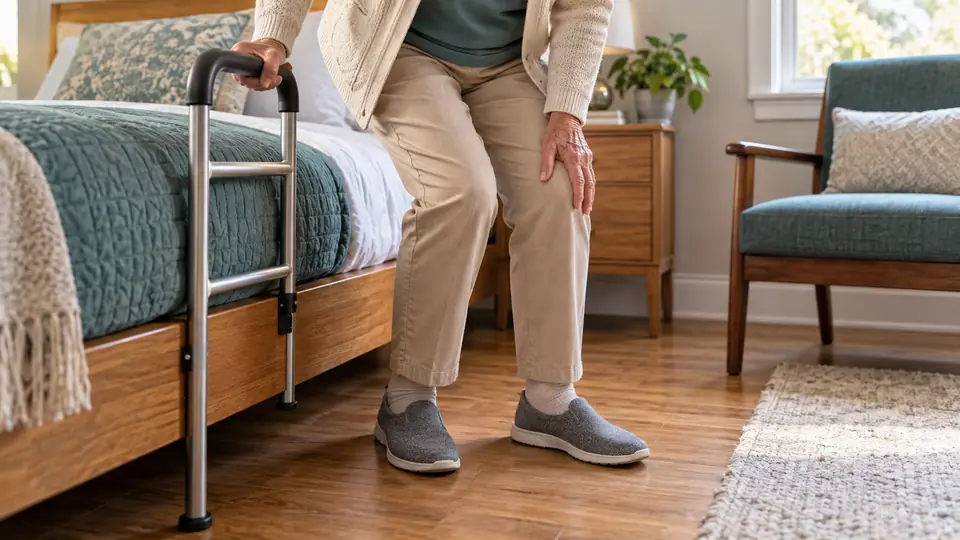

Yes. Weak legs can contribute to falls around the bed, particularly when a person is sitting down, standing up, transferring, or taking the first few steps after getting out of bed. Lower-body strength helps control these movements and recover from small losses of balance. When that strength is reduced, an otherwise routine nighttime transfer can become more difficult.
Leg weakness is rarely the only factor involved. Balance problems, dizziness, medications, vision, bed height, footwear, lighting, and the bedroom environment can all affect fall risk. The most useful approach is therefore to identify why the legs are weak and how that weakness interacts with the person’s transfers and surroundings.
Quick Answer
Can weak legs cause falls from bed? Weak legs can increase fall risk by making it harder to stand from the bed, control the transition from sitting to standing, maintain balance, and recover from a misstep. Lower-body weakness is a recognized fall risk factor in older adults, but most falls involve more than one contributing factor.
Improving strength and balance where appropriate, reviewing medications and medical conditions, making transfers easier, and reducing hazards around the bed can all form part of a broader fall-prevention plan.
Why Weak Legs Matter Around the Bed
Getting out of bed involves a sequence of movements. A person moves from lying to sitting, positions the feet, shifts body weight forward, rises to standing, stabilizes, and then begins walking. Lower-body weakness can make several stages of that sequence more difficult.
Weak legs are often only one part of the problem. Our guide to why seniors fall out of bed looks at other factors that can contribute, including balance problems, medications, nighttime movement, and the bedroom environment.
How Leg Weakness Can Contribute to Bed Falls
Lower-body strength plays an important role in transfers and walking. Weakness can affect bed-related movement in several ways:
- Difficulty standing from the bed: Moving from sitting to standing requires lower-body strength. A person who struggles to generate enough force may need several attempts, use excessive momentum, or become unstable during the movement.
- Reduced balance recovery: If the body begins to move outside its stable base of support, the legs help make rapid corrections. Weakness can make those corrections more difficult.
- Unstable first steps: The transition from standing beside the bed to walking requires both strength and balance. A person may be especially vulnerable before becoming fully steady.
- Difficulty lowering onto the bed: Weakness can also affect the ability to control the body while sitting down, potentially causing the person to sit too quickly or miss the intended position on the mattress.
- Fatigue: A person with limited strength may become less stable after repeated nighttime transfers or during periods of illness and reduced activity.
These problems can become more significant when weakness occurs together with dizziness, poor vision, pain, reduced sensation, medication effects, or an unsafe bedroom setup.
What Can Cause Weak Legs?
Leg weakness is a symptom rather than a diagnosis. It can develop gradually or appear more suddenly, and the underlying cause matters when deciding what to do about it.
Possible contributors include:
- Age-related loss of muscle strength: Muscle mass and strength can decline with age, particularly when physical activity is limited.
- Deconditioning: Extended periods of inactivity, bed rest, or reduced walking can reduce strength and endurance.
- Recent illness, surgery, or hospitalization: Mobility can decline during recovery, especially after periods of limited activity.
- Arthritis or joint pain: Pain in the hips, knees, ankles, or feet can change how a person stands and walks.
- Neurological conditions: Conditions affecting the brain, spinal cord, or peripheral nerves can influence strength, sensation, coordination, or balance.
- Medication effects: Some medications can contribute to dizziness, drowsiness, changes in blood pressure, or other effects that make transfers less stable.
- Medical or metabolic conditions: A range of health problems can contribute to fatigue, weakness, or reduced exercise tolerance.
- Nutrition and hydration problems: Inadequate nutrition or dehydration may contribute to weakness in some people and should be considered in the wider clinical picture.
New, unexplained, rapidly worsening, or one-sided weakness should not simply be attributed to aging. The appropriate urgency of medical assessment depends on the symptoms and circumstances.
Weak Legs Usually Interact With Other Fall Risks
Falls often result from several risk factors acting together rather than one isolated problem. For someone with weak legs, additional factors may include:
- Balance or gait problems
- Dizziness when sitting or standing
- Medications that affect alertness, balance, or blood pressure
- Poor vision or difficulty seeing in low light
- Frequent nighttime bathroom trips
- Inappropriate or poorly fitting footwear
- Clutter, cords, loose rugs, or other hazards near the bed
- A bed height that makes transfers unnecessarily difficult
- A mobility aid that is unavailable, incorrectly adjusted, or used inconsistently
- Cognitive impairment or nighttime confusion
The more factors that are present, the more important it becomes to assess the whole transfer rather than focusing only on muscle strength.
Who May Be at Greater Risk?
Weak legs may be particularly important when they occur in people who already have other challenges affecting safe mobility. Examples include:
- Older adults with reduced strength and balance
- People recovering from surgery, illness, or hospitalization
- People who have recently become less physically active
- Individuals with neurological or musculoskeletal conditions affecting mobility
- People who need a cane, walker, or assistance for transfers
- People who experience dizziness when standing
- People who make frequent nighttime trips to the bathroom
- Anyone who has already had a fall or near-fall while getting into or out of bed
Look at When the Fall or Near-Fall Happens
The timing and mechanics of an incident can provide useful clues about what needs attention.
Difficulty Rising From the Bed
If the person repeatedly struggles to stand, needs several attempts, or loses balance during sit-to-stand, lower-body strength, bed height, transfer technique, pain, and possible dizziness may all deserve assessment.
Unsteadiness Immediately After Standing
If standing itself is possible but the person becomes unstable immediately afterward, balance, blood pressure changes, medication effects, footwear, and access to the appropriate mobility aid may be relevant.
Problems During the First Few Steps
If the fall occurs after leaving the bed, look at gait, lighting, floor hazards, footwear, vision, and whether a walker or cane is positioned where it can be used before walking begins.
Difficulty Sitting Back Down
Weakness can also make controlled sitting difficult. A person may descend too quickly or have difficulty positioning the body correctly before sitting on the mattress.
Practical Ways to Reduce Risk
A useful prevention plan addresses both the person’s physical abilities and the environment in which transfers take place.
Have Strength, Balance, and Transfers Assessed
When weakness is affecting everyday mobility, a healthcare professional or physical therapist can assess how the person stands, walks, balances, and transfers.
Depending on the person’s abilities and medical situation, an individualized programme may include:
- Lower-body strengthening
- Balance training
- Practice moving from sitting to standing
- Walking and turning practice
- Training with an appropriate mobility aid
- Task-specific practice for getting into and out of bed
Exercises should match the person’s current abilities. Someone with substantial weakness, recent falls, significant balance impairment, or an unstable medical condition may need professional assessment before beginning exercises that challenge standing balance.
Review Bed Height
Bed height can change the physical demands of a transfer. A very low sleeping surface may require greater lower-body effort to stand, while a bed that is too high may make it difficult to place the feet securely on the floor before standing.
The most suitable height depends on the person’s body dimensions, strength, mobility, transfer technique, and whether assistance or equipment is used. Our guide to bed height for seniors explains the main factors to consider when evaluating the setup.
Keep the Bed and Mattress Stable
The sleeping surface should provide a predictable base for transfers. A bed frame that moves unexpectedly or a mattress that shifts can make standing and sitting more difficult.
Very soft or highly compressible mattresses can also change transfer mechanics for some people. If transfers are difficult, a physical or occupational therapist can evaluate the complete bed setup rather than considering mattress firmness in isolation.
Consider Transfer Supports Carefully
Some people benefit from a stable handhold when repositioning, sitting up, or transitioning between the bed and standing. Depending on the person’s needs, this might involve an appropriately selected assist handle, transfer pole, bed rail, or another transfer aid.
Adult portable bed rails are not appropriate for every person. They can create entrapment, climbing, and other hazards if the user, mattress, bed, and rail are not appropriately matched. They should not be used as restraints, and installation should follow the manufacturer’s instructions.
For someone who needs a handhold during bed mobility or transfers and has been determined to be an appropriate candidate, our guide to adjustable bed rails for elderly users compares designs intended for different bed setups and support needs.
Keep Mobility Aids Within Reach
If a person normally uses a walker or cane, the device should be positioned so it can be reached safely before the first steps away from the bed.
The mobility aid should also be appropriately fitted and maintained. A physical therapist or other qualified professional can assess whether the device is suitable and whether it is being used correctly.
Improve Nighttime Lighting
Weakness becomes more difficult to compensate for when a person cannot clearly see the floor or obstacles around the bed.
- Keep an accessible bedside light available.
- Provide useful illumination along the route to the bathroom.
- Consider motion-activated lighting where appropriate.
- Avoid lighting arrangements that create excessive glare or deep shadows.
Clear the Area Around the Bed
The first few steps after standing should not require navigating unnecessary obstacles.
- Keep cords and clutter away from walking routes.
- Address loose rugs or other surfaces that can move underfoot.
- Keep frequently used items within safe reach.
- Make sure furniture used for support is stable and appropriate for that purpose.
- Keep the route to the bathroom predictable and adequately lit.
Use Appropriate Footwear
Footwear can affect traction and stability. Shoes or slippers should fit securely and provide suitable traction for the person’s flooring and mobility needs.
Loose slippers, poorly fitting footwear, and other unstable options can make it harder to compensate for limited leg strength.
Medication and Medical Review
Weakness should not automatically be assumed to result from aging. Medication effects and medical conditions can contribute to falls and may require professional assessment.
A clinician or pharmacist can review medications when a person develops new weakness, dizziness, drowsiness, balance problems, or falls, particularly after a medication has been started or changed.
Do not stop, reduce, or change a prescribed medication solely because of a suspected connection with a fall without discussing the issue with an appropriate healthcare professional.
Nighttime Bathroom Trips and Weak Legs
Frequent nighttime toileting can expose someone with weak legs to the same difficult transfer several times during the night. Sleepiness, darkness, urgency, and fatigue may add to the challenge.
Useful strategies may include:
- Keeping the walking route clear and illuminated
- Positioning the mobility aid appropriately before bedtime
- Allowing time to become steady before walking
- Using appropriate footwear
- Discussing persistent nocturia or urgency with a healthcare professional
- Considering whether a bedside commode or other toileting adaptation is appropriate after assessment
Avoid trying to manage frequent nighttime urination simply by severely restricting fluids without professional advice, because hydration needs and the causes of nocturia vary.
A Safer Bed-Exit Sequence
There is no single transfer technique that is appropriate for everyone. People with substantial weakness, neurological conditions, recent surgery, weight-bearing restrictions, or a history of falls may require individualized training.
For someone who has already been assessed as able to transfer independently, a deliberate sequence may help avoid rushing:
- Move from lying to sitting in a controlled manner.
- Position the body securely at the edge of the bed.
- Place the feet in a stable position before attempting to stand.
- Pause if dizziness or disorientation occurs.
- Use the transfer technique and support recommended for the individual.
- Establish balance after standing before beginning to walk.
- Use the prescribed mobility aid before taking the first steps.
Recurring dizziness after sitting or standing deserves medical attention rather than being treated solely as a strength problem.
Common Mistakes to Avoid
- Assuming weakness is simply part of aging: New or worsening weakness can have many causes and may need assessment.
- Relying on a bed rail without understanding the fall mechanism: A rail may help some people with bed mobility but can create hazards for others.
- Using unstable furniture as a handhold: Lightweight bedside furniture can move or tip when loaded.
- Putting a mobility aid out of reach: A walker cannot help with the first steps if the person must walk unsupported to retrieve it.
- Changing bed height without considering transfers: Lower is not always easier, particularly for someone with limited leg strength.
- Starting challenging exercises without considering current ability: Exercise should be matched to the person’s condition and fall risk.
- Ignoring dizziness: Instability after standing may involve blood pressure, medications, or other medical factors rather than leg strength alone.
- Leaving clutter beside the bed: Weak legs reduce the margin for recovering from a trip or misstep.
When Professional Help May Be Needed
Professional assessment is particularly useful when:
- Falls or near-falls occur repeatedly during bed transfers.
- Leg weakness is new or progressively worsening.
- Weakness significantly affects standing or walking.
- The person has recently been hospitalized or had surgery.
- There is new numbness, loss of coordination, or another neurological symptom.
- Dizziness or fainting occurs during position changes.
- The person can no longer transfer safely using their previous technique.
- Caregivers are unsure how much assistance or which equipment is appropriate.
Depending on the situation, assessment may involve a primary care clinician, geriatric specialist, physical therapist, occupational therapist, pharmacist, or another relevant healthcare professional.
Sudden severe weakness, especially when accompanied by symptoms such as facial drooping, difficulty speaking, sudden confusion, loss of consciousness, severe chest symptoms, or other acute changes, requires urgent medical evaluation.
What Different Professionals Can Help With
| Professional | What They May Assess |
|---|---|
| Primary care clinician or geriatric specialist | Medical causes of weakness, dizziness, chronic conditions, and overall fall risk |
| Physical therapist | Strength, gait, balance, transfers, exercise needs, and mobility aids |
| Occupational therapist | Bed and bedroom setup, daily routines, transfer equipment, and home adaptations |
| Pharmacist | Medication effects and combinations that may contribute to dizziness, drowsiness, or instability |
Products and Adaptations: Match the Tool to the Problem
Equipment should address a clearly identified problem rather than being added automatically because someone has weak legs.
| Option | Possible Role | What to Consider |
|---|---|---|
| Walker or cane | Supports walking after the transfer | Correct type, fit, placement, and use |
| Bed assist handle or rail | May provide a handhold for selected users during bed mobility or transfers | Individual suitability, entrapment risk, bed and mattress compatibility, installation, and cognition |
| Transfer pole | May provide a fixed handhold for an appropriate transfer pattern | Structural suitability, placement, user strength, and correct installation |
| Adjustable bed | May allow changes in position or bed configuration for some users | Transfer needs, controls, mattress compatibility, and interaction with other equipment |
| Bedside commode | Can shorten the nighttime toileting route for selected users | Transfer ability, placement, hygiene, stability, and whether assistance is required |
| Bed-exit sensor or alarm | May alert a caregiver to an attempted bed exit | Does not physically prevent a fall and depends on a timely caregiver response |
How to Discuss Weak Legs and Bed Falls With a Clinician or Therapist
Specific details can make an assessment more useful. Consider describing:
- Exactly when the fall or near-fall occurs
- Whether the problem happens while sitting up, standing, or walking
- Whether one leg feels weaker than the other
- Any pain, numbness, dizziness, or changes in coordination
- Recent illnesses, surgery, hospitalization, or reductions in activity
- Current mobility aids and how they are used
- Recent medication changes
- How often the person gets out of bed at night
- Whether the person can stand from other chairs without difficulty
- Any previous falls or near-falls
A therapist may also want to observe the actual bed transfer because difficulties that are not obvious during ordinary walking can become apparent when the person tries to stand from their usual sleeping surface.
Maintaining Strength and Mobility
When weakness improves, maintaining activity can remain important. The appropriate plan depends on health, mobility, and fall risk, but may include continued strength and balance work, regular walking or other suitable physical activity, and periodic reassessment when abilities change.
Nutrition, hydration, medical conditions, pain, and medications can also influence mobility. Concerns in these areas should be addressed with the appropriate healthcare professional rather than relying on exercise alone.
Short Checklist for Weak Legs and Bed-Fall Risk
- Identify when instability occurs: sitting, standing, or walking.
- Have new or significant weakness appropriately assessed.
- Consider professional evaluation of strength, gait, and balance.
- Review medications when dizziness, drowsiness, or weakness is present.
- Check whether bed height makes transfers unnecessarily difficult.
- Keep the bed and mattress stable.
- Keep the appropriate mobility aid within safe reach.
- Provide adequate nighttime lighting.
- Remove trip hazards around the bed and bathroom route.
- Use transfer equipment only when it is suitable for the person and correctly installed.
- Reassess the plan after falls, illness, surgery, or major changes in mobility.
Frequently Asked Questions
Can weak legs alone cause someone to fall from bed?
Weak legs can contribute substantially to a fall, particularly during standing and transfers, but falls often involve several factors at once. Balance, dizziness, medications, vision, footwear, bed setup, and environmental hazards may also play a role.
Can weak legs make getting out of bed dangerous?
They can make the transfer more difficult. Standing from the bed requires enough strength to raise and control the body, while the first steps require both strength and balance. Someone who repeatedly struggles with this movement should have the cause and transfer setup assessed.
Are bed rails a good solution for weak legs?
Not automatically. An appropriately selected bed rail or assist handle may provide a useful handhold for some people, but adult portable bed rails can also create entrapment, climbing, and other hazards. Suitability depends on the person’s physical and cognitive abilities as well as the bed, mattress, rail design, and installation.
What exercises can help with weak legs?
Strength and balance training can be useful for many older adults, but the appropriate exercises and difficulty depend on the person’s abilities and health. A physical therapist can assess the person and select exercises that target the specific limitations affecting transfers and walking.
Does bed height matter if someone has weak legs?
Yes. A very low bed can require more lower-body effort to stand from, while a bed that is too high can make secure foot placement and controlled transfers difficult. There is no single ideal height for everyone; the setup should match the individual’s body dimensions and transfer abilities.
Should a walker be kept beside the bed?
If the person has been advised to use a walker for mobility, it should generally be positioned so it can be accessed safely when needed rather than requiring unsupported walking to retrieve it. Exact placement should not obstruct the transfer or create a trip hazard.
Can medications contribute to weakness and falls?
Some medications can contribute to effects such as dizziness, drowsiness, changes in balance, or blood pressure changes that increase fall risk. A clinician or pharmacist can review medications when these symptoms or new falls occur.
When is leg weakness an urgent concern?
Sudden or severe weakness can sometimes signal an acute medical problem, particularly when it occurs with symptoms such as difficulty speaking, facial drooping, sudden confusion, loss of consciousness, severe chest symptoms, or other abrupt neurological or medical changes. Seek urgent medical evaluation when symptoms suggest an emergency.
Conclusion
Weak legs can contribute to falls around the bed because lower-body strength is needed to stand, control transfers, maintain balance, and begin walking safely. The effect is often greatest when weakness occurs alongside other problems such as dizziness, poor balance, medication effects, inadequate lighting, or an unsuitable bed setup.
Rather than treating a bed rail or any other device as the automatic solution, start by identifying where the transfer is breaking down. Strength and balance assessment, an appropriate bed height, a clear and well-lit environment, access to the correct mobility aid, and review of medical or medication-related contributors can then be matched to the person’s needs.
When weakness is new, worsening, or already causing falls or near-falls, professional assessment can help identify the cause and determine whether exercise, therapy, equipment, environmental changes, medical treatment, or a combination of approaches is appropriate.