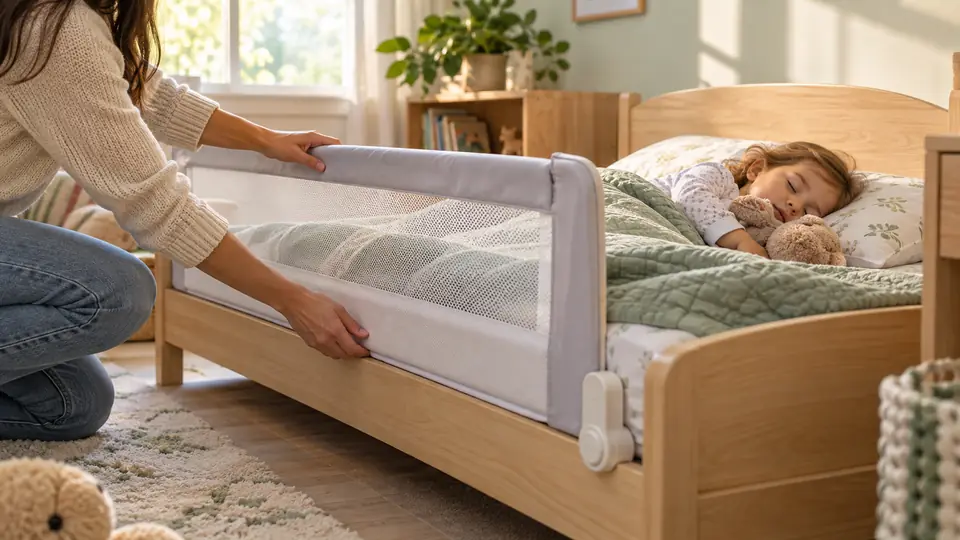

Moving from a crib to a bed is a major transition for a young child. Once the enclosed sides of the crib are gone, parents may start thinking about how to reduce the chance of a child rolling out of bed during sleep. A portable bed rail is one possible option, but choosing one requires more than simply finding a rail that fits along the edge of the mattress.
So, are bed rails safe for toddlers? Children’s portable bed rails are regulated products in the United States and are intended for children who can get in and out of an adult bed without help, typically from ages 2 to 5. They need to fit the bed and mattress correctly and be installed according to the manufacturer’s instructions. Gaps, improper assembly, incompatible mattresses, loose hardware, and use with a child who is too young can create serious hazards.
If your child is at the appropriate stage for a portable bed rail and you are comparing designs and features, our guide to bed rails for toddlers looks at options for different beds and sleep setups. Product selection should come after checking age, bed compatibility, installation requirements, and current safety information.
Quick Answer
Children’s portable bed rails can be appropriate for some children, but they are not suitable for every age or every bed. In the United States, the Consumer Product Safety Commission (CPSC) describes children’s portable bed rails as products intended for children who can get in and out of an adult bed unassisted, typically from 2 to 5 years old.
Portable bed rails should not be used with children younger than 2. For an age-appropriate child, the rail should meet applicable safety requirements, be compatible with the mattress and bed, and be assembled and installed exactly as instructed.
One of the most important hazards to prevent is entrapment. A dangerous opening can form if a rail separates from the mattress or does not fit the sleeping setup correctly. That is why fit and installation matter just as much as the style of rail.
Bed Rail Safety at a Glance
| Safety Issue | What to Check | Why It Matters |
|---|---|---|
| Child’s age and ability | Child can get in and out of the adult bed without help and falls within the product’s stated age range | Children’s portable bed rails are typically intended for ages 2 to 5 and should not be used for children younger than 2 |
| Mattress fit | Rail is compatible with the mattress dimensions and thickness specified by the manufacturer | An incompatible setup can contribute to dangerous openings or poor rail positioning |
| Entrapment gaps | No unintended gap develops between the rail, mattress, bed structure, or nearby components | Entrapment is one of the key hazards addressed by the federal safety standard |
| Installation | All anchors, straps, hardware, and locking components are installed exactly as directed | Incorrect assembly or displacement can create unsafe openings or instability |
| Product condition | No damaged mesh, bent frame, loose hardware, broken locks, or missing components | A damaged rail may no longer perform as designed |
| Recalls and warnings | Check the product and manufacturer against current safety notices | Products can be recalled or subject to safety warnings after sale |
What Is a Children’s Portable Bed Rail?
A children’s portable bed rail is designed to be installed on an adult bed to help prevent a child from falling out. Under U.S. safety rules, these products are intended for children who can get in and out of an adult bed without assistance, typically between 2 and 5 years old.
The category includes more than traditional rigid metal-and-mesh rails. Some nonrigid products made from materials such as foam or inflatable materials can also fall within the definition of a portable bed rail.
This distinction matters because a children’s portable bed rail is not the same thing as an adult portable bed rail, a crib side, or a permanently integrated guardrail on a toddler bed. Different product categories can be subject to different requirements.
Why Parents Consider Bed Rails During the Crib-to-Bed Transition
A crib provides physical boundaries around the sleeping surface. Moving to an open bed removes much of that containment, and some children continue to move considerably during sleep.
A portable bed rail can provide a boundary along part of the mattress edge while a child becomes accustomed to sleeping in a more open bed. It should not, however, be treated as a substitute for an age-appropriate bed, correct installation, or a safe bedroom setup.
The crib-to-bed transition is also one of the situations in which mattress size, rail length, and ease of getting in and out of bed can affect which design is practical. If you are specifically shopping for this stage, our comparison of bed rails for toddlers transitioning to a bed focuses on that narrower use case.
What U.S. Safety Rules Say About Children’s Portable Bed Rails
In the United States, children’s portable bed rails are covered by a federal safety standard under 16 CFR Part 1224. The regulation incorporates requirements from ASTM F2085, the Standard Consumer Safety Specification for Portable Bed Rails.
The requirements address several potential hazards and aspects of product construction, including:
- Structural integrity
- Openings and enclosed openings
- Openings that can develop when a bed rail is displaced
- Openings between the rail and parts of the bed
- Installation components and hardware
- Protrusions
- Sharp points and edges
- Small parts
- Misassembly
- Required labeling and warnings
These requirements are important because a bed rail does not merely need to remain upright. It also needs to avoid creating dangerous spaces as the product, mattress, and bed interact during use.
Parents should therefore look beyond marketing terms such as “extra safe” or “heavy duty.” Check whether the product is intended for the child’s age, whether it is designed for the particular type of bed and mattress, and whether the manufacturer provides complete installation and safety instructions.
Why Entrapment Is an Important Bed Rail Hazard
Entrapment is one of the most important hazards associated with improperly designed, installed, or fitted bed rails. A space can develop between the mattress and rail or between components of the sleeping setup. If a child’s body enters an opening that is not intended to be accessible, the consequences can be serious.
This is not merely a historical concern. The federal standard specifically contains performance requirements addressing openings and openings created when portable bed rails are displaced.
CPSC has also continued to issue warnings about children’s portable bed rails that fail applicable requirements and create entrapment hazards. For parents, that makes product compliance, fit, installation, and recall checks particularly important.
What to Check After Installation
Once the rail is installed, inspect the complete sleeping setup rather than looking only at the rail itself.
- Confirm that the rail is installed in the exact position shown in the instructions.
- Check that required anchors, straps, locks, and hardware are secured correctly.
- Look for unintended spaces between the mattress and rail.
- Make sure the mattress is within the size and thickness range specified for the product.
- Confirm that the rail does not shift away from the mattress during ordinary use.
- Recheck the installation after moving the bed, mattress, or rail.
Do not invent your own acceptable gap measurement. Use the manufacturer’s installation and inspection instructions rather than relying on rules such as “two fingers” unless that measurement is specifically provided for the product.
Are Bed Rails Safe for a 2-Year-Old?
A children’s portable bed rail may be appropriate for some 2-year-olds if the child can get in and out of an adult bed without assistance and the product is intended for that child’s age and sleeping setup.
The CPSC describes children’s portable bed rails as typically intended for children ages 2 to 5 who can get in and out of an adult bed unassisted. Product-specific instructions can be more restrictive, so the manufacturer’s stated age range and use requirements still matter.
A portable bed rail should not be used as a way to move a younger child to an adult bed before that child is developmentally ready for the sleeping arrangement.
Are Bed Rails Safe for Children Under 2?
Children’s portable bed rails should not be used for children younger than 2. CPSC-required warnings specifically address this age restriction because younger children can face serious entrapment hazards.
If a child is still at an age when an appropriate crib or another age-specific sleep product should be used, a portable rail attached to an adult bed should not be treated as a substitute.
Bed Rail Safety Depends on the Bed and Mattress
A rail can be well made and still be inappropriate for a particular sleeping setup. Mattress thickness, mattress dimensions, bed construction, rail attachment method, and nearby bed components all affect compatibility.
Before purchasing or installing a rail, check the manufacturer’s specifications for:
- Compatible mattress sizes
- Permitted mattress thickness
- Compatible bed types
- Required foundation or support structure
- Installation and anchoring method
- Placement restrictions
- Age limitations
Do not assume that a rail described as “universal” necessarily works with every mattress, bed frame, adjustable base, bunk bed, platform bed, or other sleeping configuration.
Common Types of Bed Rails for Children
Children’s portable bed rails come in several designs. The best fit depends on the product’s instructions, the bed and mattress, and how the sleeping space is arranged.
| Type | How It Works | What to Check |
|---|---|---|
| Rigid or mesh portable rail | Creates a raised boundary along part of the mattress edge | Mattress compatibility, anchoring, openings, rail height, and installation |
| Fold-down or swing-down rail | Allows the rail section to move for easier bed access | Locking mechanism, correct operating position, anchoring, and fit |
| Longer portable rail | Covers a greater portion of the mattress edge | Whether the length and attachment system are appropriate for the specific bed |
| Foam or inflatable boundary | Creates a raised boundary on or near the sleeping surface | Product instructions, age range, mattress fit, positioning, and applicable safety requirements |
| Integrated toddler-bed guardrail | Forms part of a toddler bed rather than being added as a portable accessory | Use the bed and its guard components according to the bed manufacturer’s instructions |
These designs should not be ranked with homemade labels such as “low,” “high,” or “very high” safety. Safety depends on whether a particular product meets applicable requirements and is appropriate for the child, mattress, bed, and installation.
Does a Longer Bed Rail Mean a Safer Bed?
Not automatically. A longer rail covers more of an edge, but length alone does not establish that a product is safer.
A longer rail still needs to be compatible with the mattress and bed, remain correctly secured, avoid hazardous openings, and be used within its stated age and installation requirements.
There may also need to be appropriate access for the child to get in and out of bed. Follow the product’s intended configuration rather than attempting to create a completely enclosed sleeping area from components that were not designed for that purpose.
What About Full-Perimeter Bed Rail Systems?
Products that surround multiple sides of a mattress should not automatically be described as providing “very high protection.” More barriers also mean more connections, openings, attachment points, and installation details that need to be evaluated.
If considering a multi-panel setup, verify that the entire configuration is specifically permitted by the manufacturer. Do not combine unrelated rails or improvise an enclosure around an adult mattress.
The correct question is not how enclosed the bed looks. It is whether the complete setup is designed, tested, installed, and used for that configuration.
Are Foam Bed Bumpers Safer Than Rigid Bed Rails?
It is better not to assume that one category is inherently safer simply because it is soft or rigid. CPSC guidance notes that some nonrigid products, including foam and inflatable designs, can meet the definition of a children’s portable bed rail and fall within the scope of the applicable standard.
Evaluate the specific product rather than relying on material alone. Check its intended age range, installation method, mattress requirements, instructions, and current safety status.
Can a Toddler Climb Over a Bed Rail?
Yes. A bed rail should not be treated as a restraint or as a structure designed to keep a determined child confined to the bed.
If a child repeatedly attempts to climb over the rail, reconsider whether that particular setup is appropriate. Climbing can introduce a different fall hazard, particularly when the sleeping surface is elevated.
A lower sleeping surface or a different age-appropriate bed arrangement may be worth considering if climbing becomes part of the child’s behavior.
How to Install a Toddler Bed Rail More Safely
The exact installation process depends on the product, so the manufacturer’s instructions should take priority over generic online advice.
As a general checklist:
- Read the complete instructions before assembling the rail.
- Confirm that the child, mattress, and bed meet the product’s stated requirements.
- Use every required installation component.
- Do not substitute straps, hardware, or other components.
- Position the rail exactly where the instructions specify.
- Secure all anchors and locking mechanisms as directed.
- Check the finished installation for unintended openings.
- Make sure the rail does not shift away from the mattress.
- Keep unused or excess components secured as directed by the manufacturer.
- Reinspect the setup periodically and after moving the mattress, bed, or rail.
If you cannot install the rail in the configuration shown by the manufacturer, do not improvise a different attachment method.
Pay Attention to Straps and Installation Components
Some portable bed rails use straps as part of their retention system. These components need to be installed and stored exactly as directed.
Loose or improperly managed components can introduce hazards of their own. Do not leave unused straps, loops, cords, or hardware accessible around the sleeping area, and do not modify the retention system to make it fit a bed for which it was not designed.
If a strap, anchor, buckle, or other installation component is damaged or missing, stop using the rail until the issue can be resolved according to the manufacturer’s instructions.
Check for Recalls and Safety Warnings
Buying a children’s product from a major online marketplace does not by itself establish that the product is currently free from safety concerns.
Before using a portable bed rail, particularly an unfamiliar model or a secondhand product, check for current recalls or safety warnings. This is also useful if you cannot identify the manufacturer, model number, or installation instructions.
Recent safety actions have involved children’s portable bed rails that created entrapment hazards or failed requirements related to openings, structural integrity, or hardware. If a safety agency tells consumers to stop using a particular product, discontinue use rather than attempting a homemade modification.
Be Careful With Secondhand Bed Rails
A used bed rail may be missing instructions, labels, straps, anchors, hardware, or other components. Its history may also be unknown.
Before using a secondhand rail, make sure you can positively identify the manufacturer and model, obtain the correct instructions, verify that all required parts are present, and check for recalls or safety warnings.
If the product cannot be identified or assembled exactly as intended, replacing it is preferable to guessing how it should be installed.
Bed Rails and Different Bed Types
Do not assume that a portable bed rail works with every style of bed.
Platform Beds
The mattress support and frame design may affect whether the rail’s retention system can be installed as intended. Check the product’s compatibility requirements.
Adjustable Beds
Movement of an adjustable base changes the geometry around the mattress. Do not use a portable rail with an adjustable bed unless the manufacturer specifically permits that configuration.
Bunk Beds
Do not add a portable bed rail to a bunk bed unless the product and bed manufacturers specifically permit that use. Bunk beds have their own guardrail and age-related safety considerations, and an improvised portable rail can create additional openings or hazards.
Queen and King Beds
A larger mattress does not necessarily require the longest rail available. Compatibility and installation matter more than simply maximizing coverage. If you are considering a larger adult bed, check both the rail manufacturer’s mattress specifications and the bed’s construction before selecting a product.
Using Bed Rails While Traveling
Travel can make bed-rail compatibility more complicated because hotel beds, vacation-rental beds, and guest-room mattresses may be very different from the child’s usual bed at home. A rail that fits correctly on one mattress should not be assumed to fit another.
Before using a portable bed rail away from home, check the unfamiliar bed and mattress against the product’s compatibility and installation requirements. Make sure the rail can be installed exactly as directed and inspect the finished setup for unintended openings or movement.
Portability also becomes more important when the rail needs to fit into luggage or move between sleeping locations. Parents comparing options specifically for trips can see our guide to travel bed guards for children, which covers portable designs intended for different travel and temporary sleeping setups.
Make the Whole Bedroom Safer
A bed rail addresses only one part of the sleeping environment. The rest of the room still deserves attention.
Depending on the child’s age and room layout, consider:
- Keeping sharp or hard furniture away from the immediate bedside area
- Making sure furniture that could tip is appropriately secured
- Keeping window cords and other strangulation hazards inaccessible
- Keeping the route in and out of bed clear
- Using an age-appropriate bed and mattress setup
- Avoiding improvised barriers made from furniture, pillows, boxes, or unrelated products
A portable bed rail should be one component of an appropriate sleep environment, not the only safety measure considered.
When a Portable Bed Rail May Not Be the Right Choice
A portable rail may not be suitable when:
- The child is younger than the permitted age
- The child cannot get in and out of the adult bed without assistance
- The mattress or bed is incompatible with the rail
- The required installation components cannot be attached correctly
- The rail creates an unintended opening after installation
- The product is damaged or missing components
- The child repeatedly attempts to climb over the rail
- The product is subject to a recall or safety warning
In those situations, reconsider the sleeping arrangement rather than modifying the rail or ignoring its instructions.
When Can a Child Stop Using a Bed Rail?
There is no single birthday on which every child needs to stop using a rail. Children’s portable bed rails are generally intended for a limited developmental period, typically ages 2 to 5, but product-specific age limits still apply.
As a child becomes comfortable in the bed and no longer needs the additional boundary, the rail may no longer be necessary. A child who has begun climbing over the rail may also need a different setup rather than continued use of the same barrier.
Follow the manufacturer’s age restrictions and reassess the sleeping arrangement as the child grows.
Common Bed Rail Safety Mistakes
- Using a portable bed rail for a child under 2: children’s portable bed rails are not intended for this age group.
- Assuming every rail fits every bed: mattress thickness and bed construction can affect compatibility.
- Ignoring a gap: an unintended opening between the mattress and rail should not be dismissed as normal.
- Improvising installation: adding homemade straps, hardware, padding, or other modifications can create new hazards.
- Using missing or damaged components: the rail should be assembled with the components specified by its manufacturer.
- Assuming softness means safety: foam and inflatable designs still need to be evaluated as products intended for a particular use.
- Skipping recall checks: safety information can change after a product reaches the market.
- Treating the rail as a restraint: a portable bed rail is not designed to confine a child who is trying to climb out.
Frequently Asked Questions
Are bed rails safe for 2-year-olds?
A children’s portable bed rail may be appropriate for a 2-year-old who can get in and out of an adult bed without assistance, provided the specific rail is intended for that age and is compatible with the bed and mattress. Follow the manufacturer’s instructions and restrictions.
Are bed rails safe for an 18-month-old?
Children’s portable bed rails should not be used for children younger than 2. CPSC-required warnings for these products specifically address this restriction.
Can toddlers get trapped between a bed rail and mattress?
Entrapment is a recognized hazard that the federal portable bed rail standard is designed to address. An improperly fitted, displaced, defective, or noncompliant rail can create dangerous openings. Correct product selection and installation are therefore essential.
Are foam bed bumpers safer than metal bed rails?
Do not assume that one is safer based only on the material. Some foam and inflatable products fall within the definition of portable bed rails. Evaluate the specific product’s age range, instructions, compatibility, safety requirements, and current recall status.
Do bed rails prevent every fall from bed?
No. A bed rail should not be treated as a guarantee against every possible fall. It provides a boundary along the portion of the sleeping surface it is designed to protect, but the overall setup, exposed areas, child behavior, installation, and bed height still matter.
Can I use an adult bed rail for a toddler?
Do not assume that an adult portable bed rail is suitable for a child. Children’s and adult portable bed rails are separate regulated product categories in the United States. Use a product specifically intended for the child’s age and application.
Can I use a toddler bed rail on a queen bed?
Only if the specific product is designed and approved by its manufacturer for that mattress and bed configuration. Mattress size alone does not establish compatibility.
Should a bed rail touch the mattress?
The rail should be installed exactly as its manufacturer specifies. Because dangerous openings between rails and mattresses are a recognized hazard, do not accept an unexplained gap or try to fill one with improvised padding.
How often should I check a bed rail?
Inspect it regularly and whenever the bed, mattress, bedding setup, or rail has been moved. Check for loosening, damage, displacement, missing hardware, and unintended openings. Follow any inspection schedule provided by the manufacturer.
Are bed rails required when moving from a crib to a bed?
Not every child or bed transition requires a portable rail. Whether one is appropriate depends on the child’s age and ability, the type of bed, the sleeping setup, and the product’s intended use. Some toddler beds have integrated guardrails, while other sleeping arrangements use different designs.
Bottom Line: Are Bed Rails Safe for Toddlers?
Children’s portable bed rails can be an appropriate part of the transition to an adult bed for children who are old enough and able to get in and out of bed independently. In the United States, these products are typically intended for children ages 2 to 5 and are subject to federal safety requirements addressing hazards such as dangerous openings, structural integrity, hardware, and misassembly.
The important point is that a bed rail is not automatically safe simply because it is marketed for toddlers. Safety depends on using an appropriate product with the right child, bed, and mattress; installing it exactly as directed; checking for dangerous openings and damage; and paying attention to recalls and safety warnings.
For children younger than 2, children’s portable bed rails should not be used. For older toddlers and preschool-age children, follow the specific manufacturer’s age, compatibility, installation, and use instructions rather than relying on generic assumptions about rail length, material, or design.
If a rail cannot be installed correctly, creates an unintended gap, is damaged, or is subject to a safety warning, stop using it and choose an appropriate alternative rather than modifying the product yourself.